MFI
  • HOME
  • About
    • About MFI
    • Testimonials
  • Services
    • Accounting and Banking
    • Financial Planning
    • Medical Practice Management
  • Contact
  • Careers
  • Latest News
  • Search
  • Menu Menu
  • Facebook
  • LinkedIn

Your Tax Deadlines for November 2024

Tax
  • 07 November – Monthly PAYE submissions and payments
  • 25 November – Value Added Tax (VAT) manual submissions and payments
  • 28 November – Excise duty payments
  • 29 November – VAT electronic submissions and payments, Corporate Income Tax Provisional Tax payments where applicable.

Disclaimer: The information provided herein should not be used or relied on as professional advice. No liability can be accepted for any errors or omissions nor for any loss or damage arising from reliance upon any information herein. Always contact your professional adviser for specific and detailed advice.

© CA(SA)DotNews

January 15, 2025
https://www.mfi.co.za/wp-content/uploads/2025/01/0500bb09-96d2-40a6-a886-db0a88f8461b.jpg 300 650 MFI http://www.mfinc.co.za/wp-content/uploads/2023/09/cropped-cropped-MFI-Logo-Icon.jpg MFI2025-01-15 08:26:292026-03-13 07:52:00Your Tax Deadlines for November 2024

How To Avoid an eFiling Profile Hijacking

Tax, Technology

“…it is vital that all stakeholders in the digital ecosystem, including the taxpayers, SARS, and the banks, work together to prevent and combat profile hijacking.” (SARS)

The recent spike in the number of SARS eFiling profiles being hacked by cybercriminals should raise red flags for every taxpayer. It’s got so bad that the Minister of Finance has given the Office of the Tax Ombud (OTO) approval to conduct a review of SARS’ service failures in assisting taxpayers timeously with eFiling profile hijacking.

This is a type of cybercrime in which fraudsters use phishing, malware, or social engineering to access and modify your personal or professional profile on a digital platform like SARS’ eFiling without your knowledge or consent.

Has this ever happened to you?
  • You receive an email, SMS, or WhatsApp, seemingly from SARS, asking you to click on a link or attachment to update your profile, verify your information, or claim a refund. It appears legitimate, and not realising it’s a fake, you just do as the message says…
  • You receive a call from someone pretending to be a SARS official, asking you to confirm your personal details or to click on a link, and you do, not realising that it will install malware on your device…
  • You are contacted by someone pretending to be a SARS official, offering you tax assistance or advice, and asking you to share your login credentials, OTP, or personal information with them, and you do…

Fraudsters use methods like these to trick you into revealing your login credentials. An alarming number of taxpayers have fallen victim to these unscrupulous predators, despite continuous system enhancements to secure and strengthen the security of SARS’ channels.

What could happen if my SARS eFiling profile is hacked?

Fraudsters can access and modify your details (e.g. contact number, password) without your knowledge or consent – with serious consequences for your tax compliance and financial security.

They can then also change the bank details to divert a SARS refund due to you into their own accounts. And they can even submit fraudulent returns on your behalf to claim refunds!

How can I prevent profile hijacking?

Prevention is far better than cure. Here are a few pointers, direct from SARS.

  • Use a strong and unique password for your eFiling profile. Change it regularly.
  • Don’t use the same password for other online accounts or services.
  • Never share your login credentials, OTP, or personal information with anyone, even if they claim to be from SARS.
  • If you hear about a security compromise at any organisation you deal with, immediately log in to your account and update your password.
  • Always access eFiling through the official website (https://www.sars.gov.za) or the SARS eFiling mobi app.
  • Do not click on any links or attachments in emails, SMSes or WhatsApps that claim to be from SARS, and never “confirm” or submit your login details after clicking on a link.
  • Keep your computer and mobile devices updated with the latest security software and antivirus programs.
  • Activate multi-factor or “app” authentication on your eFiling profile. This will authenticate you every time you log in by sending an OTP message to your registered mobile number or email address or requesting you to authorise the action via your mobile phone.
We can help to keep you safe

As your accountants, we are well versed in avoiding these scams. Whenever you receive communications that seem to be from SARS, simply contact us.

  • We are alerted to all known scams claiming to be from SARS, so we can quickly help you to identify phishing attempts.
  • We can check your eFiling profile and tax information regularly and report any discrepancies or unauthorized changes to SARS immediately.
  • We constantly update our security details to ensure the safety of our profile and our clients’ profiles.
In summary

SARS itself recognises that profile hijacking is a serious crime that harms taxpayers. But prevention is always better than cure. Take proactive steps to protect your security and contact us whenever you receive communications that seem to be from SARS. 

Disclaimer: The information provided herein should not be used or relied on as professional advice. No liability can be accepted for any errors or omissions nor for any loss or damage arising from reliance upon any information herein. Always contact your professional adviser for specific and detailed advice.

© CA(SA)DotNews

January 15, 2025
https://www.mfi.co.za/wp-content/uploads/2025/01/e-filing_650.jpg 300 650 MFI http://www.mfinc.co.za/wp-content/uploads/2023/09/cropped-cropped-MFI-Logo-Icon.jpg MFI2025-01-15 08:26:042026-03-13 07:52:00How To Avoid an eFiling Profile Hijacking

Ready to Submit Your Interim EMP501 Reconciliation By 31 October?

Tax

“The interim reconciliation process has become an integral part of the employer reconciliation and assists employers…” (SARS)

Employers are assisted by the interim EMP501 reconciliation, says SARS, because it makes it easier to:

  • make more accurate annual reconciliation submissions
  • maintain an up-to-date employee database
  • register employees for income tax purposes

Of course, there are other benefits, such as maintaining your compliant tax status, and avoiding wasting money on stiff penalties and interest.

It goes without saying that you want to reap all these benefits for your business. Allow us to help you to understand what needs to be done. We will be able to assist in ensuring a smooth, hassle-free submission process – even with the next deadline right around the corner.

EMP501 Reconciliation fast facts
  • All employers are required to submit an EMP501 Reconciliation
  • There are two deadlines in each tax year. For the 2025 tax year the deadlines are:
    • 31 October 2024 – 2025 Interim Reconciliation (for the period 1 March 2024 – 31 August 2024)
    • 31 May 2025 – 2025 Annual Reconciliation (for the period 1 September 2024 – 28 February 2025)
Potential pitfalls

The EMP501 Reconciliation is an intricate process which creates many opportunities for errors:

  • Payroll information must be verified
  • Correct deduction of employees’ tax (PAYE), Skills Development Levy (SDL), and Unemployment Insurance Fund (UIF) contributions must be verified
  • Deductions must reconcile with IRP5 / IT3(a) tax certificates
  • Employment Tax Incentive (ETI) values claimed must be reconciled
  • EMP201 returns must be reconciled with actual payments made to SARS
  • EMP201 returns must be reconciled with EMP501 statements
  • Employee information needs to be updated on eFiling
  • Employees without tax numbers must be registered
  • Employer’s Reconciliation Declaration (EMP501) needs to be submitted via the eFiling website or the e@syFile application

This is an intricate and time-consuming process, and, as SARS puts it, “accuracy and timely filing are critical”.

Consequences of non-compliance

This is serious business. Inaccuracies or late submission can result in severe consequences.

  • Calculating PAYE liability incorrectly will result in the imposition of both penalties and interest. This includes corrections made on the EMP501 reconciliation, as any shortfall is attributed to the last month of the reconciliation period.
  • If an employer submits their EMP501 late, administrative penalties will be charged. The penalty will equal 1% of the year’s PAYE liability, increasing each month by 1% (up to a maximum of 10% of the year’s PAYE liability).
  • An employer who wilfully or negligently fails to submit an EMP201 or EMP501 return to SARS is guilty of an offence and could face a fine or imprisonment for a period of up to two years.
The bottom line

The penalties are stiff, and the submission process is fraught with opportunities for inaccuracies and errors. We understand the importance of tax compliance to your business. And we have the expertise and experience to help ensure a smooth and stress-free submission for you. 

Disclaimer: The information provided herein should not be used or relied on as professional advice. No liability can be accepted for any errors or omissions nor for any loss or damage arising from reliance upon any information herein. Always contact your professional adviser for specific and detailed advice.

© CA(SA)DotNews

January 15, 2025
https://www.mfi.co.za/wp-content/uploads/2025/01/Recon_Deadline650.jpg 300 650 MFI http://www.mfinc.co.za/wp-content/uploads/2023/09/cropped-cropped-MFI-Logo-Icon.jpg MFI2025-01-15 08:25:372026-03-13 07:52:00Ready to Submit Your Interim EMP501 Reconciliation By 31 October?

Tax Deadlines

Tax
  • 07 October – Monthly PAYE submissions and payments
  • 21 October – End of filing season for individual taxpayers (non-provisional)
  • 25 October – Value Added Tax (VAT) manual submissions and payments
  • 30 October – Excise duty payments
  • 31 October – VAT electronic submissions and payments, Corporate Income Tax Provisional Tax payments where applicable, and Personal Income Tax Top-up Provisional Tax payments.

Disclaimer: The information provided herein should not be used or relied on as professional advice. No liability can be accepted for any errors or omissions nor for any loss or damage arising from reliance upon any information herein. Always contact your professional adviser for specific and detailed advice.

© CA(SA)DotNews

January 15, 2025
https://www.mfi.co.za/wp-content/uploads/2025/01/TimeForTax650.jpg 300 650 MFI http://www.mfinc.co.za/wp-content/uploads/2023/09/cropped-cropped-MFI-Logo-Icon.jpg MFI2025-01-15 08:25:262026-03-13 07:52:00Tax Deadlines

Beware the Taxman When Accessing Your Three-Pot Retirement Savings!

Investment, Tax

“The two-pot system is meant to support long-term retirement savings while offering flexibility to help fund members in financial distress.” (National Treasury)

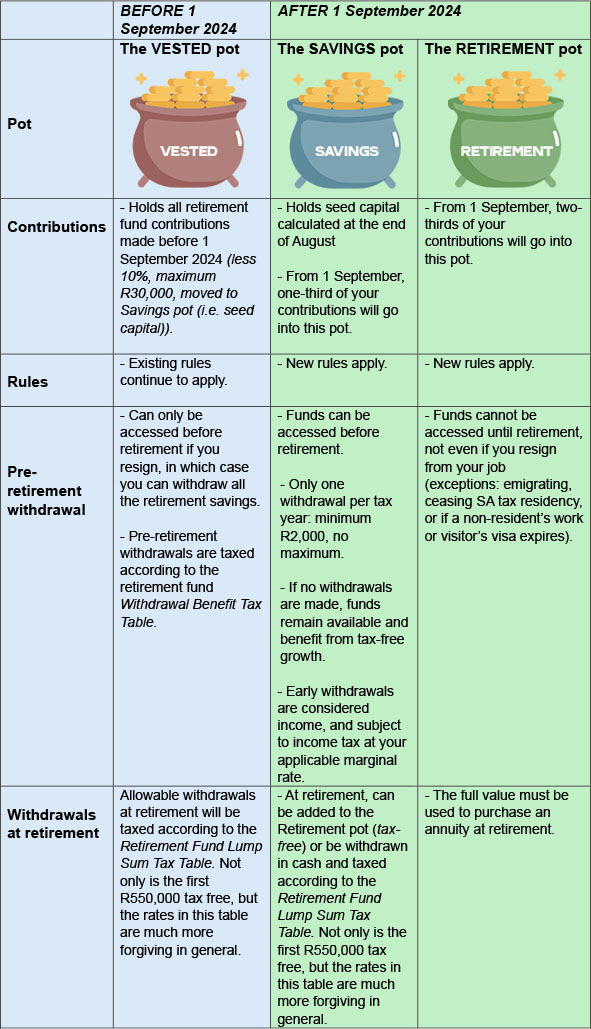
With two new pots added to what used to be the one-pot South African retirement system, fund members can now access a portion of their retirement savings before retirement, while still preserving savings for retirement. There are, however, immediate and long-term tax and other implications that should be carefully considered!

The three pots of the new retirement system
Tax and other issues

Withdrawing from any of the pots should be approached with caution. In addition to the fees that will be charged, and the potentially devastating impact on your eventual retirement savings, there are also tax implications that must be carefully considered.

  • It’s significantly more expensive from a tax perspective to withdraw retirement funds before retirement age (normally 55), because the Withdrawal Benefit Tax Table or Individual’s Tax Table will apply. Instead, waiting until retirement to access savings – when the Retirement Fund Lump Sum Benefits or Severance Benefits Tax Table applies – is a far better tax option.
  • Up to R550,000 drawn as a cash lump sum at retirement may be tax free. However, this R550,000 is a cumulative withdrawal total over your lifetime. That means this tax benefit could be eroded by pre-retirement withdrawals.
  • Transfers from the Vested and Savings pots into the Retirement pot are also tax-free.
  • Employer contributions are still treated as taxable fringe benefits.
  • Early withdrawals from your Savings pot are considered income and are subject to income tax as per the tax directive the fund manager will request from SARS. What’s more, any outstanding taxes you owe SARS will automatically be deducted if you make a withdrawal.
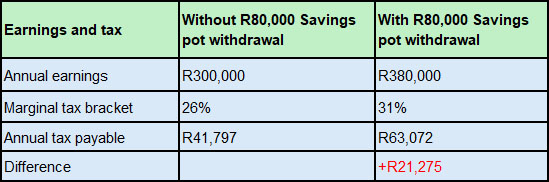
  • Depending on your annual income and the amount withdrawn, a pre-retirement withdrawal from your Savings pot – taxed at your individual marginal tax rate – could also push you into a higher tax bracket. This would mean paying more tax on all your income for the year. Here’s an example of the potential impact of withdrawing R80,000 from your Savings pot. Waiting until retirement age to withdraw the same amount could be tax-free.
Hidden costs of early withdrawals

Your full retirement fund contribution (one-third Savings pot; two-thirds Retirement pot) is still tax deductible up to 27.5% of annual income, up to a maximum R350,000 per tax year. This remains one of the biggest tax breaks out there, but is effectively cancelled out by the tax payable on an early withdrawal. Early withdrawals also have another cost – the loss of tax-free growth that could have been earned on your savings.

Continuing with the example above, if the R80,000 is not withdrawn, but instead left to grow at an average annual return of 10% for 25 years, the projected returns are R866,776 (equivalent to R201,958 in today’s terms assuming 6% inflation). This means you could lose tax-free growth of R121,958 by withdrawing just R80,000!

Help is at hand!

Understanding the tax and other implications of early retirement fund withdrawals in the short term and at retirement will help you to make better-informed financial decisions.

Early retirement fund withdrawals are likely to be more expensive in tax and lost investment growth compared to other options such as overdraft facilities, credit cards or home loans.

Please talk to us if you or any of your employees are considering retirement fund withdrawals. We’re here to help!

Disclaimer: The information provided herein should not be used or relied on as professional advice. No liability can be accepted for any errors or omissions nor for any loss or damage arising from reliance upon any information herein. Always contact your professional adviser for specific and detailed advice.

© CA(SA)DotNews

January 15, 2025
https://www.mfi.co.za/wp-content/uploads/2025/01/three-pots_650.jpg 300 650 MFI http://www.mfinc.co.za/wp-content/uploads/2023/09/cropped-cropped-MFI-Logo-Icon.jpg MFI2025-01-15 08:25:162026-03-13 07:52:00Beware the Taxman When Accessing Your Three-Pot Retirement Savings!

How to Survive Trust Tax Season 2024

Tax

“A Trust is a ‘person’ for tax purposes and is therefore a taxpayer in its own right.” (SARS)

With Tax Season 2024 for trusts opening on 16 September, there’s no better time to draw trustees’ attention to SARS’ continued emphasis that all trusts must register for income tax purposes, including dormant trusts. Once registered, trusts are obligated to submit income tax returns that are aligned with other trust reporting requirements from SARS and substantiated by extensive supporting documents and information.

Trustees are held responsible for non-registration of trusts for income tax, and they will not be able to evade enforcement actions by blaming third parties for failing to file returns. “But I didn’t know I was meant to,” is not a valid excuse.

Trust tax returns can be filed from 16 September 2024 (much later than the usual June/July opening) until 20 January 2025.

Along with the new filing season dates, trusts also face several onerous compliance requirements – and some stiff potential penalties.

Onerous requirements
  • SARS introduced changes to the Income Tax Return for Trusts (ITR12T) last year, with additional probing questions, and even more mandatory supporting documents.
  • The range of mandatory and supporting documents that must be submitted with the ITR12T depends on the trust type, and may include:
    • All certificates and documents relating to income and deductions
    • Trust Deed and Letters of Authority
    • Resolutions/minutes of trustee meetings
    • Details of the ‘Main’ Trustee (the SARS registered representative)
    • Financial statements and/or administration accounts
    • Particulars of assets and liabilities
    • Confirmation of banking details
    • Proof of payment of any tax credits
    • Supporting schedules
  • Detailed disclosure of the beneficial ownership, including the submission of identity documents of all beneficial owners. This information will be checked against the beneficial ownership register lodged with the Master of the High Court. Non-compliance could result in a trustee receiving a fine of up to R10 million, a prison sentence of up to 5 years – or both.
  • To provide SARS with a clearer understanding of the assets, income and activities within trust structures, trust returns now feature additional questions such as any local or foreign amounts vested in the trust as a beneficiary of another trust.
  • Information reported on the trust tax return must also align with the IT3(t) reporting of prescribed information by trusts, now also mandated by SARS. It includes trust distributions and their beneficiaries, trust and beneficiary demographic information, trust financial flows, and amounts vested in a beneficiary, including net income, capital gains and capital amounts. The first IT3(t) certificates are due to be submitted at the end of September 2024 for the 2023/24 tax year, and then on an annual basis.
  • Despite the above reporting deadline, SARS confirmed that trust beneficiary income tax returns will not be pre-populated with IT3(t) data for the 2024 year of assessment. This means trustees must also provide details of trust beneficiaries’ 2024 trust earnings timeously to the beneficiaries for inclusion in their personal income tax returns, for which the submission deadlines remain unchanged despite the change in the trust tax filing season.
We can help you survive Tax Season 2024!

Without professional assistance, surviving trust Tax Season 2024 would be a tough ask. The complexity of the processes and the new requirements exponentially increase the risk of errors. And that’s before you factor in the significant time required to manually upload the extensive list of supporting documents – especially in light of SARS’ increased efforts to improve tax compliance and the severe penalties for non-compliance.

Luckily, you can rely on our friendly, professional assistance to ensure all the compliance boxes are ticked and penalties are avoided this trust Tax Season.

Disclaimer: The information provided herein should not be used or relied on as professional advice. No liability can be accepted for any errors or omissions nor for any loss or damage arising from reliance upon any information herein. Always contact your professional adviser for specific and detailed advice.

© CA(SA)DotNews

January 15, 2025
https://www.mfi.co.za/wp-content/uploads/2025/01/Trust_Tax_650.jpg 300 650 MFI http://www.mfinc.co.za/wp-content/uploads/2023/09/cropped-cropped-MFI-Logo-Icon.jpg MFI2025-01-15 08:24:442026-03-13 07:52:00How to Survive Trust Tax Season 2024

Your Tax Deadlines for September 2024

Tax
  • 06 September – Monthly Pay-As-You-Earn (PAYE) submissions and payments
  • 16 September – Start of Filing Season 2024: Trusts
  • 25 September – Value Added Tax (VAT) manual submissions and payments
  • 27 September – Excise duty payments
  • 30 September – VAT electronic submissions and payments, Corporate Income Tax Provisional Tax payments where applicable, and Personal Income Tax Top-up Provisional Tax payments.

Disclaimer: The information provided herein should not be used or relied on as professional advice. No liability can be accepted for any errors or omissions nor for any loss or damage arising from reliance upon any information herein. Always contact your professional adviser for specific and detailed advice.

© CA(SA)DotNews

January 15, 2025
https://www.mfi.co.za/wp-content/uploads/2025/01/7b3c62b7-249c-4a1f-9edd-81833d2f718b.png 298 650 MFI http://www.mfinc.co.za/wp-content/uploads/2023/09/cropped-cropped-MFI-Logo-Icon.jpg MFI2025-01-15 08:24:322026-03-13 07:52:01Your Tax Deadlines for September 2024
Page 6 of 6«‹456

Pages

  • About
  • Accounting and Banking
  • Careers
  • Careers-PTA01
  • Contact
  • Financial Planning
  • HOME
  • Latest News
  • Medical Practice Management
  • MFI Team
  • Testimonials

Categories

  • Accounting
  • Business
  • Company / Corporate / Compliance
  • DotNews
  • Economy
  • Employment and Labour
  • Employment and Labour Law
  • Financial
  • Investment
  • Tax
  • Technology
  • Trusts
  • Uncategorized
  • Wills and Estate Planning

Archive

  • July 2026
  • June 2026
  • May 2026
  • April 2026
  • March 2026
  • January 2026
  • November 2025
  • October 2025
  • September 2025
  • August 2025
  • July 2025
  • June 2025
  • May 2025
  • April 2025
  • March 2025
  • February 2025
  • January 2025
  • July 2023
  • June 2023
  • May 2023
  • April 2023
  • March 2023
Standard POPI Act Privacy Policy Statement

Scroll to top