MFI
  • HOME
  • About
    • About MFI
    • Testimonials
  • Services
    • Accounting and Banking
    • Financial Planning
    • Medical Practice Management
  • Contact
  • Careers
  • Latest News
  • Search
  • Menu Menu
  • Facebook
  • LinkedIn

Tax Avoidance vs Tax Evasion: Toeing the Line

Tax

“The difference between tax avoidance and tax evasion is the thickness of a prison wall.” (Denis Healey, former UK Chancellor of the Exchequer)

The line between tax avoidance and tax evasion can sometimes appear blurry, especially in complex transactions or fierce tax planning strategies. The comparison below is a good starting point:
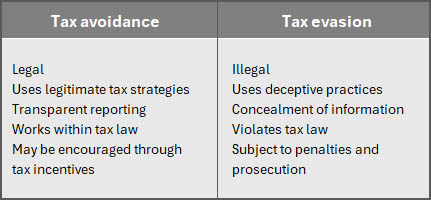

What is tax avoidance?

Tax avoidance refers to legal arrangements or transactions designed to reduce or eliminate tax liability, without breaking the law.

Examples of tax avoidance include:

  • Moving a company into a special economic zone for the sole reason of achieving a lower corporate income tax rate.
  • Timing the sale of capital assets to control the timing of capital gains and losses.
  • Getting your company to pay for a motor vehicle or other expenditure as it may, depending on the circumstances, be taxed at a lower rate. 
  • Placing a large amount of your income into a retirement fund to obtain the highest deduction possible.
  • Investing in tax-free savings accounts (this applies to individuals only).

Often termed “permissible tax planning”, tax avoidance is legal and accepted. However, when tax avoidance becomes overly aggressive or artificial (i.e., lacking commercial substance), it may cross into what tax authorities consider “impermissible” or “abusive” tax avoidance. This, while not necessarily criminal, may be challenged under anti-avoidance rules such as the General Anti-Avoidance Rule (GAAR).

South Africa employs GAAR to counteract tax avoidance strategies that exploit loopholes. These rules allow tax authorities to disregard or re-characterise transactions that have the primary purpose of avoiding tax.

What is tax evasion?

Tax evasion is characterised as the illegal act of deliberately and intentionally avoiding paying taxes, either by avoiding paying tax entirely, or by illegally reducing or deferring taxes payable. It can involve hiding or ignoring one’s tax liability by making false representations or statements, or hiding income or information that would otherwise be subject to taxation.

Examples of tax evasion include:

  • Failing to file required tax returns 
  • Making false statements on tax returns 
  • Failing to declare income or deliberately underreporting income
  • Claiming personal expenses as business expenses
  • Over-declaring expenses, which may include falsifying invoices
  • Using multiple entities without legitimate business purpose
  • Moving money through multiple accounts to obscure its source

SARS uses data-driven insights, self-learning computers, and artificial intelligence to combat tax evasion, and is empowered to conduct criminal investigations into tax offences and work with the criminal justice system to prosecute offenders.

Tax evasion can result in severe penalties of up to 200% of the shortfall in tax, plus interest, and even jail sentences of five years or more.

Best practices for legal tax avoidance
  1. Stay updated with ever-changing tax legislation to make informed decisions.
  2. Structure your business operations or transactions in a manner that legally minimises taxes – for example, operating as a sole proprietorship or a private company have different tax implications.   
  3. Engage in permissible tax planning by adhering to all tax laws and regulations, and avoiding abusive tax schemes designed to exploit loopholes in the tax laws.
  4. Utilise all tax deductions, credits, exemptions and incentives, including deductions for business expenses, tax credits for certain investments or activities.
  5. Comply with reporting requirements and avoid penalties and interest by filing accurate tax returns on time.
  6. Maintain accurate records of all your financial transactions and tax-related documents to ensure all claims and deductions can be substantiated when required by SARS.  
  7. Ensure transparency and full disclosure by always providing full and accurate information on tax returns: concealing information or providing misleading details can easily cross the line into tax evasion.
Best practice as a service

By adhering to these best practices, taxpayers can effectively employ tax avoidance strategies without crossing the line into the realm of tax evasion.  

The best way to ensure all these best practices are implemented in your tax affairs is simply to work with our team of tax professionals. We are knowledgeable about the ever-changing tax laws and have the expertise and experience to provide tailored advice and solutions that keep you on the right side of the law while minimising your tax burden to the full extent permissible. 

Disclaimer: The information provided herein should not be used or relied on as professional advice. No liability can be accepted for any errors or omissions nor for any loss or damage arising from reliance upon any information herein. Always contact us for specific and detailed advice.

© AccountingDotNews
May 28, 2025
https://www.mfi.co.za/wp-content/uploads/2025/05/624150e4-74cf-475e-96ad-2c92e5457117.jpg 300 650 MFI http://www.mfinc.co.za/wp-content/uploads/2023/09/cropped-cropped-MFI-Logo-Icon.jpg MFI2025-05-28 09:10:332026-03-13 07:51:07Tax Avoidance vs Tax Evasion: Toeing the Line

Budget 3.0: VAT Increase Out, Fuel Levy Hikes In

Business, Economy, Financial, Tax

Last month’s Budget 3.0 withdrew the contentious proposed VAT changes. This resulted in inflation-linked fuel levy increases of 16c for petrol and 15c for diesel, from 4 June.

Other tax proposals from March’s Budget – including static personal tax thresholds, reduced transfer duties, and sin tax increases – remain unchanged.

The tax measures contained in Budget 3.0 will raise an additional R18bn in 2025/26. A further R20bn in tax measures are postponed to Budget 2026 – unless SARS collects an extra R35bn in uncollected taxes, for which Budget 3.0 allocated an additional R4bn in funding.

Disclaimer: The information provided herein should not be used or relied on as professional advice. No liability can be accepted for any errors or omissions nor for any loss or damage arising from reliance upon any information herein. Always contact us for specific and detailed advice.

© AccountingDotNews
May 28, 2025
https://www.mfi.co.za/wp-content/uploads/2025/05/ebb63f62-a2e7-4562-a206-2fe262d437b6.jpg 300 650 MFI http://www.mfinc.co.za/wp-content/uploads/2023/09/cropped-cropped-MFI-Logo-Icon.jpg MFI2025-05-28 08:49:282026-03-13 07:51:07Budget 3.0: VAT Increase Out, Fuel Levy Hikes In

Your Tax Deadlines for June 2025

Tax
  • 06 June – PAYE submissions and payments    
  • 25 June – VAT manual submissions and payments    
  • 27 June – Excise duty payments 
  • 30 June – VAT electronic submissions and payments, & CIT Provisional Tax payments where applicable.

Disclaimer: The information provided herein should not be used or relied on as professional advice. No liability can be accepted for any errors or omissions nor for any loss or damage arising from reliance upon any information herein. Always contact us for specific and detailed advice.

© AccountingDotNews
May 28, 2025
https://www.mfi.co.za/wp-content/uploads/2025/05/c711d1c5-bc3c-4e25-9e85-89bf8806a63b.png 298 650 MFI http://www.mfinc.co.za/wp-content/uploads/2023/09/cropped-cropped-MFI-Logo-Icon.jpg MFI2025-05-28 08:42:532026-03-13 07:51:07Your Tax Deadlines for June 2025

Mind The Tax Gap! Here’s How…

Tax

“In 2025/26, SARS will focus on addressing the tax gap to improve revenue collection.” (National Treasury Budget Review)

With additional funding from National Treasury, SARS will now be better positioned than ever to collect the estimated R800 billion in unpaid taxes which SARS Commissioner Edward Kieswetter has identified as a better alternative than a VAT hike to balance the South African Budget. 

Much of the estimated R800 billion in unpaid taxes consists of the so-called “tax gap” – the difference between how much tax is legally due to SARS and the amount that is actually paid on time. SARS has reported the following: 

  • Just over R400 billion in undisputed uncollected debt
  • Over R100 billion in debt currently under dispute
  • More than 54 million outstanding returns dating back several years
  • 156,000 South Africans with substantial economic activity who are not registered taxpayers, or are not filing their tax returns. 

The remainder of the R800 billion unpaid taxes is made up by “aggressive tax planning” such as base erosion, transfer pricing, and other means of tax evasion, as well as unpaid excise duties, unpaid VAT, and illicit trade flows.

Kieswetter said R2 billion of the additional R2.5 billion that SARS will receive for 2025/26 will be used for “a massive debt recovery programme”, while R500 million will be used to modernise SARS’ systems.   

Given SARS’ enhanced capabilities and focus on collecting outstanding debt, our tax expertise will be crucial in ensuring you and your business maintain complete compliance and react immediately and correctly should your tax affairs become the subject of SARS’ scrutiny. 

Tax compliance tick box 

Maintaining compliance starts with:

✔ Being registered for all applicable tax types within the stipulated time frames
✔ Making accurate declarations
✔ Filing returns and other required documentation on time
✔ Paying the correct amount of tax on time
✔ Promptly responding to SARS communications
✔ Paying penalties and interest for non-compliance, such as late submissions or under-declared income.

How we can help you mind the tax gap  

We can help you to comply with your specific tax obligations with up-to-date tax expertise and best practices. 

  • We promptly and professionally respond to communications from SARS, such as notices of demand for unfiled returns, requests for information, or notifications of penalties levied.
  • We take immediate and correct action following demands for outstanding tax debts. Taxpayers have ten business days after receiving a Final Demand to either pay, arrange deferral of payment or make a payment arrangement, file a suspension of payment with an objection, or enter into a compromise agreement.

What’s more, our expertise and experience enable us to monitor that SARS is following the correct legal procedures. This ensures that your taxpayer rights are protected and preventing illegal collection measures such as unauthorised SARS withdrawals from bank accounts. 

Bottom line

SARS says it will be relentless in its efforts to collect the billions of rands in uncollected taxes, and that it is ready to act against those who wilfully and defiantly ignore their legal tax obligations. 

Similarly, we will be relentless in ensuring you maintain complete tax compliance in all your affairs. And we are ready to take the proper and timely action when SARS’ spotlight shines on your tax affairs. 

Disclaimer: The information provided herein should not be used or relied on as professional advice. No liability can be accepted for any errors or omissions nor for any loss or damage arising from reliance upon any information herein. Always contact us for specific and detailed advice.

© AccountingDotNews
April 24, 2025
https://www.mfi.co.za/wp-content/uploads/2025/04/gap_650.png 300 650 MFI http://www.mfinc.co.za/wp-content/uploads/2023/09/cropped-cropped-MFI-Logo-Icon.jpg MFI2025-04-24 06:32:212026-03-13 07:51:07Mind The Tax Gap! Here’s How…

Your Tax Deadlines for May 2025

Tax
  • 07 May – PAYE submissions and payments
  • 23 May – VAT manual submissions and payments
  • 29 May – Excise duty payments
  • 30 May – VAT electronic submissions and payments, & CIT Provisional Tax payments where applicable.

Disclaimer: The information provided herein should not be used or relied on as professional advice. No liability can be accepted for any errors or omissions nor for any loss or damage arising from reliance upon any information herein. Always contact us for specific and detailed advice.

© AccountingDotNews
April 24, 2025
https://www.mfi.co.za/wp-content/uploads/2025/04/df60bfad-8922-42a4-bcb7-6bba14f2bf2d.jpg 298 650 MFI http://www.mfinc.co.za/wp-content/uploads/2023/09/cropped-cropped-MFI-Logo-Icon.jpg MFI2025-04-24 05:47:182026-03-13 07:51:07Your Tax Deadlines for May 2025

Budget 2025: How It Affects You and Your Business

Business, Economy, Financial, Tax

“… the economy needs to grow much faster and in an inclusive manner. This is the central objective of the current administration.” (Finance Minister Enoch Godongwana – Budget 2025)

The tabling of Finance Minister Enoch Godongwana’s fourth Budget in February was marked by an unprecedented three-week postponement, following a deadlock around the original Budget proposal to increase VAT by 2%.

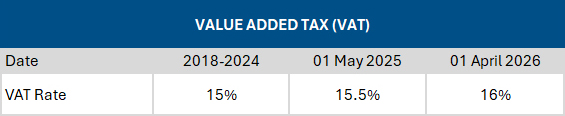
A revised Budget, finally tabled on 12 March, proposed a 0.5% increase from 1 May 2025, with a second 0.5% VAT increase from 1 April 2026 – but the proposal was still not enough to satisfy most other political parties.

In his Budget Speech, the finance minister called the Budget proposals “a bold and pragmatic approach” to ensure the economy grows “much faster and in an inclusive manner”. He admitted that the economy has stagnated for over a decade, with GDP growth averaging less than 2%, while forecasts for medium-term GDP growth are a dismal 1.8%.

While the powers that be attempt to reach consensus on the Budget 2025 proposals, businesses and individuals in South Africa will find little support from the fiscus to survive these low-growth economic conditions. 

This is evident from our overview below of the most pertinent Budget 2025 proposals. In a nutshell, the finance minister is trying to cover another substantial Budget shortfall by directly and indirectly increasing the tax burden on corporate and individual taxpayers.

Budget proposals that will impact you 
  • The 0.5% VAT increases proposed for 2025 and 2026 will impact every South African, while disproportionately affecting lower-income households strained by high electricity costs, inflation and interest rates in a weak economy. To alleviate their impact on poor households, the list of zero-rated food items is extended to include canned vegetables, dairy liquid blends, and organ meats from sheep, poultry and other animals.
  • Personal income tax brackets will not be adjusted for inflation for a second year running. This means that, like last year, individuals who receive a salary increase will again pay more tax, and could be pushed into a higher tax bracket.
  • No inflation adjustments were proposed for tax rebates or medical tax credits – which once again translates into more tax payable by individuals.
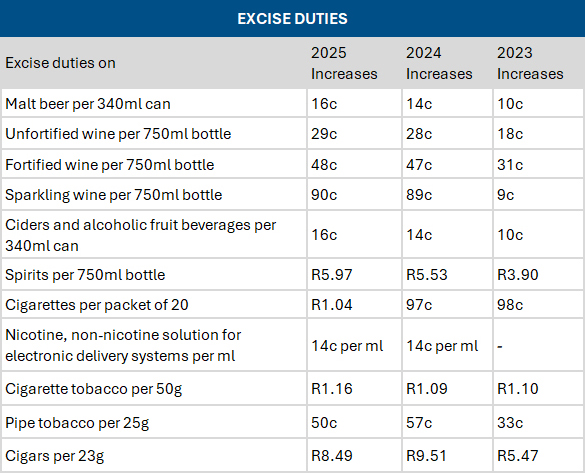
  • Above-inflation increases in the excise duties on alcohol (6.75%) and tobacco (4.75 – 6.75%) are no surprise. This means that with immediate effect, the duty on:
    • a 340ml can of beer increases by 16c
    • a 750ml bottle of unfortified wine goes up by 29c
    • a 750ml bottle of fortified wine goes up by 48c
    • a 750ml bottle of spirits will increase by R5.97
    • a 23g cigar goes up by R8.49
    • a pack of 20 cigarettes rises by R1.04
    • vaping products increase by 14c per millilitre.
  • Changes to the rules regarding the tax treatment of cross-border retirement funds are proposed. 
  • A one-year extension in the R370 social relief of distress (SRD) grant and above-inflation increases ranging from R30 to R130 per month in other social grants will provide minimal relief to the poorest South African households.
  • SARS has been allocated R3.5 billion this year and an additional R4 billion over the medium term to enhance its tax collection capabilities, so taxpayers can expect increased scrutiny and administration.  
Budget proposals that will impact your business 

The 0.5% VAT increases proposed for 1 May 2025 and 1 April 2026 will certainly impact all companies in South Africa’s struggling economy, with a disproportionately negative impact on the small and micro businesses that are crucial to economic growth. 

  • VAT hikes directly raise the cost of goods and services, impacting competitiveness and profitability.
  • Higher prices resulting from the VAT increase will reduce consumer purchasing power in an already-constrained economy.
  • The VAT increase could trigger inflationary pressures, further eroding household incomes and potentially forcing an interest rate hike.
  • Two VAT increases over two years will also result in a significant administrative burden on businesses to implement the required changes to their systems.
  • Carbon taxes increased from R190 to R236 per tonne on 1 January, while the temporary incentive for renewable energy introduced in 2023 has not been extended.
  • From 1 April 2025, the formula to calculate the employment tax incentive and the eligible income bands will be adjusted.
  • It is proposed that the sunset date for the urban development zone tax incentive be extended by five years to 31 March 2030. 
  • The Budget proposes to cancel the inflationary increase in the health promotion levy, and that the ad valorem excise duties on smartphones are limited to higher value phones.
Some good news
  • The general fuel levy and the Road Accident Fund levy will not be increased again this year, providing tax relief of R4 billion. However, the carbon tax on fuel and diesel will increase. Budget 2025 also proposes an adjustment to the diesel refund for the primary sector for the next tax year.
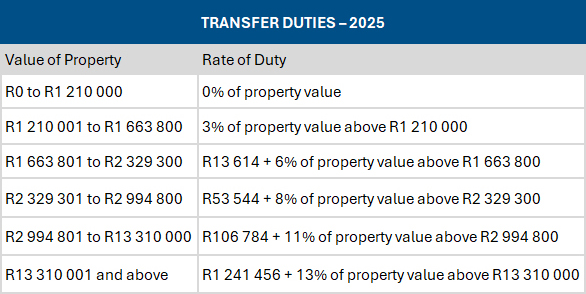
  • Property buyers will benefit from an upward adjustment of 10% in transfer duty brackets from 1 April 2025.
  • A R1 trillion investment over the next three years in public infrastructure spending, focussed on transport and logistics, energy, and water and sanitation, should positively impact on the economy.
  • Besides the proposals detailed above, Budget 2025  made no mention of a wealth tax or the National Health Insurance (NHI).
  • In a media interview following the Budget Speech, the minister said that if the economy does well, the VAT increase in 2026 may not be necessary. 
How best to manage your taxes going forward? 

There is (at time of writing) uncertainty as to whether or not the Minister will proceed with his proposed tax changes – even if he fails to garner sufficient political support to ultimately ensure their adoption by parliament.  If he does proceed, it’s equally unclear how long they will be valid for. Regardless, expect a lot of political manoeuvring and perhaps some major changes in the weeks ahead! 

As tax collection remains government’s main source of income and SARS’ tax collection capabilities have been extended with billions in funding, you would be well-advised to rely on our expertise and advice to determine the impact of Budget 2025 on your tax affairs. 

Disclaimer: The information provided herein should not be used or relied on as professional advice. No liability can be accepted for any errors or omissions nor for any loss or damage arising from reliance upon any information herein. Always contact us for specific and detailed advice.

© AccountingDotNews
March 28, 2025
https://www.mfi.co.za/wp-content/uploads/2025/03/Budget-2025-650.jpg 300 650 MFI http://www.mfinc.co.za/wp-content/uploads/2023/09/cropped-cropped-MFI-Logo-Icon.jpg MFI2025-03-28 11:28:512026-03-13 07:51:07Budget 2025: How It Affects You and Your Business

Budget 2025: Your Tax Tables and Tax Calculator

Tax

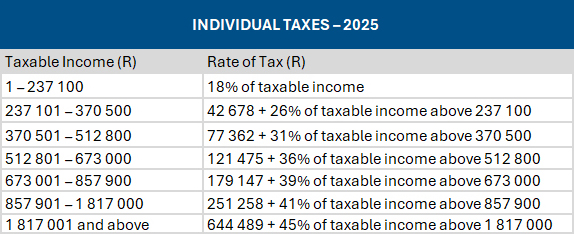
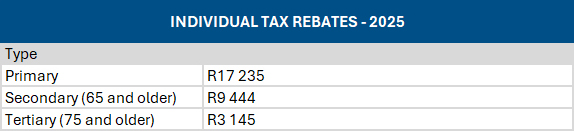
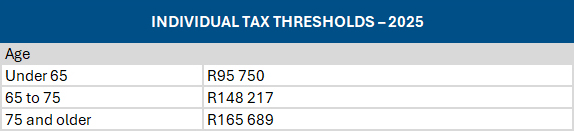
Budget 2025, if adopted by Parliament,  will effectively bring about an increase in personal income tax by not adjusting the tables for tax rates, rebates and credits, while also implementing substantial increases in ‘sin’ taxes and introducing a 0.5% VAT increase on 1 May 2025 and another 0.5% increase effective 1 April 2026.  

This selection of official SARS Tax Tables and other useful resources will help clarify your tax position for the new tax year. 

Individual taxpayers: Tax tables unchanged since 2023


Source: SARS


Source: SARS


Source: SARS

Sin taxes raised


Source: Adapted from Budget 2025 People’s Guide

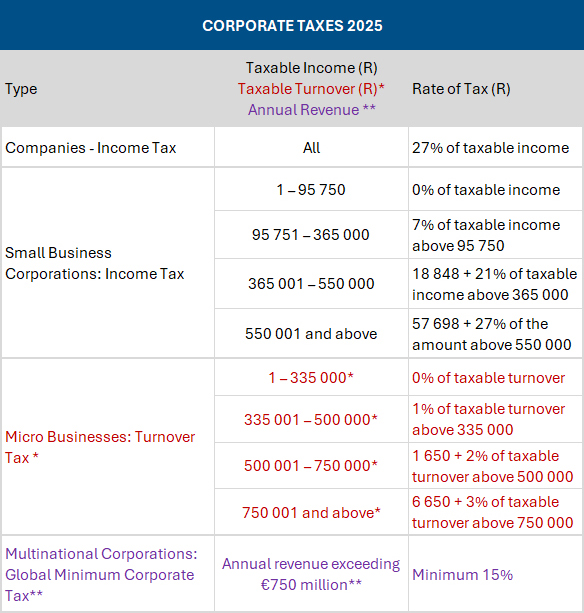
Businesses: Corporate tax rates unchanged


Source: Adapted from SARS Budget Tax Guide 2025

Proposed VAT increases


Source: Adapted from Budget 2025 People’s Guide

Transfer duty: 10% upward adjustment from 1 April


Source: SARS’ Budget Tax Guide 2025

How much will you be paying in income, petrol and sin taxes?

Use Fin 24’s four-step Budget Calculator here to find out the monthly and annual impact on your income tax, as well as what you will be paying in fuel and sin taxes.

Bear in mind, however, that the best way to fully understand the impact of the proposals in Budget 2025 on you and your business is to reach out to us for professional advice.

Disclaimer: The information provided herein should not be used or relied on as professional advice. No liability can be accepted for any errors or omissions nor for any loss or damage arising from reliance upon any information herein. Always contact us for specific and detailed advice.

© AccountingDotNews
March 28, 2025
https://www.mfi.co.za/wp-content/uploads/2025/03/tax-tables-650.jpg 300 650 MFI http://www.mfinc.co.za/wp-content/uploads/2023/09/cropped-cropped-MFI-Logo-Icon.jpg MFI2025-03-28 11:23:422026-03-13 07:51:07Budget 2025: Your Tax Tables and Tax Calculator

Why Use a Registered Tax Practitioner? Here’s What SARS Says…

Tax

“A tax professional is someone who solves a problem you didn’t know you had in a way you don’t understand.” (Carl Ally, adapted from a quote about architects)

With tax compliance scrutiny intensifying and SARS increasing its detection capabilities with “the latest technology, artificial intelligence, and data science”, South African businesses face mounting pressure to keep their tax affairs 100% in order.

To achieve and maintain this compliance, the expertise of a tax practitioner is invaluable – provided you are using a correctly registered practitioner.

Do I even need a tax practitioner? 

The specialised knowledge that registered tax practitioners offer greatly benefits businesses and individuals to navigate more complex tax matters, including: 

  • multiple income streams 
  • multiple tax obligations (income tax, VAT, PAYE, SDL, UIF)
  • optimisation of complex deductions
  • industry-specific tax considerations
  • capital gains calculations
  • strategic tax planning opportunities.

Businesses that attempt to navigate tax matters alone or with unregistered help face significant risks like: 

  • missed opportunities for legitimate tax efficiency
  • exposure to penalties and interest charges for errors or oversights
  • increased likelihood of verifications and audits
  • reputational damage
  • potential criminal liability in cases of serious mistakes and omissions.

Using a registered tax practitioner can significantly reduce these risks, free up time to focus on your core business, and eliminate the stress of tax-related challenges.

Why must a tax practitioner be registered? 

Section 240(1) of the Tax Administration Act mandates that anyone who provides tax advice or completes tax returns on behalf of others must be registered with both SARS and a Recognised Controlling Body, such as SAIPA, SAICA, SAIT or CIBA.

To provide clients with assurance that their tax affairs are in capable hands, these professional bodies impose stringent criteria on registered tax practitioners, ensuring they are: 

  • qualified according to stringent industry-recognised criteria
  • up-to-date with current tax legislation and professional development
  • bound by professional codes of conduct or ethics
  • accountable to a professional regulatory body
  • able to provide recourse for substandard service or fraudulent activities
  • covered by Professional Indemnity insurance
  • supported by a technical support team for resolving complex tax issues.
More benefits of using a registered tax practitioner

Tax clarity and tailored tax advice: As SARS updates requirements and introduces new compliance measures, a registered practitioner can expertly advise your business in the evolving tax landscape.

Strategic advice on legitimate tax efficiency measures like tax planning and structuring, industry-specific tax opportunities for your business, and additional services to streamline tax compliance. 

Critical protection is provided by ensuring accurate and compliant tax calculations and returns, maintaining documentation for potential audits, and proactively identifying and addressing potential compliance issues.

Direct representation during SARS engagements including lodging and managing disputes, and experienced negotiation capabilities. 

Insurance cover: A registered tax practitioner carries Professional Indemnity insurance – providing an additional layer of protection should errors occur.  

Maximise value from our tax team 

As SARS intensifies its compliance efforts, the guidance and protection offered by our professional tax team will become increasingly valuable.

Employing a registered tax practitioner is about much more than meeting a compliance requirement – it’s a strategic advantage that delivers expertise, protection, and peace of mind and helps secure your business’s reputation and financial future.

How do I know if a Tax Practitioner is registered? 
  1. Ask them for their PR Number.   
  2. Visit SARS’ Tax Practitioner Verification Link.
  3. Enter the PR Number to confirm ongoing registration.

Disclaimer: The information provided herein should not be used or relied on as professional advice. No liability can be accepted for any errors or omissions nor for any loss or damage arising from reliance upon any information herein. Always contact us for specific and detailed advice.

© AccountingDotNews

March 28, 2025
https://www.mfi.co.za/wp-content/uploads/2025/03/registered-650.jpg 300 650 MFI http://www.mfinc.co.za/wp-content/uploads/2023/09/cropped-cropped-MFI-Logo-Icon.jpg MFI2025-03-28 11:18:002026-03-13 07:51:07Why Use a Registered Tax Practitioner? Here’s What SARS Says…

Your Tax Deadlines for April 2025

Tax
  • 01 April – Start of the 2025/26 Financial Year         
  • 07 April – PAYE submissions and payments            
  • 25 April – VAT manual submissions and payments            
  • 29 April – Excise duty payments      
  • 30 April – VAT electronic submissions and payments, & CIT Provisional Tax payments where applicable.

Disclaimer: The information provided herein should not be used or relied on as professional advice. No liability can be accepted for any errors or omissions nor for any loss or damage arising from reliance upon any information herein. Always contact us for specific and detailed advice.

© AccountingDotNews

March 28, 2025
https://www.mfi.co.za/wp-content/uploads/2025/03/5251526f-a0c9-4363-abaf-5fe01d70b2fe.jpg 300 650 MFI http://www.mfinc.co.za/wp-content/uploads/2023/09/cropped-cropped-MFI-Logo-Icon.jpg MFI2025-03-28 10:53:382026-03-13 07:51:30Your Tax Deadlines for April 2025

Disagree with SARS? Here’s How we Can Assist You

Tax

“When taxpayers are aggrieved by an assessment or a decision that is subject to objection and appeal, they have a right to dispute it.” (SARS)

As a taxpayer in South Africa, you have the right to dispute tax assessments, if you have valid reason to disagree with SARS on the interpretation of either the relevant facts involved, or the laws that apply to the facts, or both.

SARS has a well-established dispute resolution process – but it is also time-consuming and often complex, with strict deadlines and a substantial amount of administration.

Here’s how we can help you manage the timelines and process for a (hopefully) successful dispute against a SARS assessment, including those that create unmanageable tax liabilities.

A solid foundation is paramount
  • Before lodging an objection, it’s crucial to make a Request for Reasons for a SARS assessment, which will detail SARS’ findings of fact and the law it applied. You need this to build a solid objection.
  • All substantiating documentation required for the objection must be collated, as it must be submitted with your objection within the objection period.
  • It’s also important to ensure your other tax affairs are compliant, as your overall tax compliance status can influence SARS’ decision-making process.
  • Maintaining updated contact details with SARS, checking your compliance status regularly, and reacting promptly to notification emails or SMSes from SARS are all vital – but we can take care of this for you.
Pay now, argue later

Where a disputed assessment involves a tax debt, the debt must be paid even if you are submitting an objection, thanks to SARS’ “pay now, argue later” principle. This is often a substantial challenge for taxpayers. 

If you want to avoid paying immediately, a “Request for Suspension of Payment” must also be submitted timeously, in a separate process. If granted, this will prevent SARS from commencing collection proceedings on the outstanding amount until the objection is finalised.

Ducks in a row

Submitting a tax objection is a serious business. The validity and strength of the arguments and evidence to be presented in the objection should be carefully – and objectively – evaluated.

The objection must detail the grounds on which the assessment is disputed, set out the parts or amounts in dispute and, depending on the nature of the dispute, address penalties and interest incurred. Substantiating documentation that provides evidence for the objection must be collated and submitted to SARS within the objection period.

The bottom line: professional tax expertise is highly recommended when drafting an objection.

Keep to tight deadlines

Meeting the tight timelines is crucial for protecting your right as a taxpayer to dispute an assessment. By acting quickly and meeting deadlines, we can help you to ensure the best chances of resolving the dispute favourably.

Important deadlines include:

  • You have 30 business days after the date of assessment to make a Request for Reasons, which will extend the period within which an objection can be lodged. 
  • The law allows 80 business days to file a Notice of Objection (NOO) against a SARS assessment or decision, starting on the date of assessment, or, where a Request for Reasons was made, from the date of receiving the reasons requested from SARS.
  • 30 business days from the date of the outcome of your objection, a Notice of Appeal can be submitted if the objection is disallowed or partially allowed.

If you have missed a deadline due to valid reasons, we can help you request an extension – although ideally you should request an extension before missing a deadline. 

Monitor and manage the dispute process

To protect your rights in a tax dispute, it’s important to manage the dispute process to ensure SARS adheres to set time frames and service expectations. SARS is obliged to:

  • respond to a Request for Reasons within 45 business days. 
  • request additional substantiating documents for an objection within 30 business days. 
  • where SARS requests additional documents for an objection, notify the taxpayer of the outcome within 45 business days of the submission deadline or delivery date of the requested documents.
  • where SARS does not request additional documents for objection, advise the taxpayer of the outcome of the objection, together with its reasons, within 60 business days of the objection.
  • issue an assessment within 45 days after a settlement is reached.

If the outcome of an objection is not acceptable, a Notice of Appeal can be filed, and Alternative Dispute Resolution (ADR) can be considered. We can assist you to request for an ADR from SARS, as this may provide for a more cost-effective and expedited dispute resolution process.

Matters that cannot be resolved by ADR can be referred to either the tax board or tax court, depending on the disputed amount and the complexity of a case. If the outcome of an appeal to the tax board or tax court is not satisfactory, an appeal to the High Court or Supreme Court of Appeal may also be possible.

Tax expertise at your fingertips

Tax disputes can be complicated and time-consuming, and missing the deadlines can erode your right as a taxpayer to object to an assessment.
 
We can guide you through the steps, ensuring you meet all the requirements and deadlines and greatly increasing your chances of a positive outcome.

Disclaimer: The information provided herein should not be used or relied on as professional advice. No liability can be accepted for any errors or omissions nor for any loss or damage arising from reliance upon any information herein. Always contact us for specific and detailed advice.

© AccountingDotNews

February 26, 2025
https://www.mfi.co.za/wp-content/uploads/2025/02/6329ba99-10c0-4282-8a14-9c5d46262afa.jpg 300 650 MFI http://www.mfinc.co.za/wp-content/uploads/2023/09/cropped-cropped-MFI-Logo-Icon.jpg MFI2025-02-26 14:14:012026-03-13 07:51:30Disagree with SARS? Here’s How we Can Assist You
Page 4 of 6«‹23456›»

Pages

  • About
  • Accounting and Banking
  • Careers
  • Careers-PTA01
  • Contact
  • Financial Planning
  • HOME
  • Latest News
  • Medical Practice Management
  • MFI Team
  • Testimonials

Categories

  • Accounting
  • Business
  • Company / Corporate / Compliance
  • DotNews
  • Economy
  • Employment and Labour
  • Employment and Labour Law
  • Financial
  • Investment
  • Tax
  • Technology
  • Trusts
  • Uncategorized
  • Wills and Estate Planning

Archive

  • July 2026
  • June 2026
  • May 2026
  • April 2026
  • March 2026
  • January 2026
  • November 2025
  • October 2025
  • September 2025
  • August 2025
  • July 2025
  • June 2025
  • May 2025
  • April 2025
  • March 2025
  • February 2025
  • January 2025
  • July 2023
  • June 2023
  • May 2023
  • April 2023
  • March 2023
Standard POPI Act Privacy Policy Statement

Scroll to top