MFI
  • HOME
  • About
    • About MFI
    • Testimonials
  • Services
    • Accounting and Banking
    • Financial Planning
    • Medical Practice Management
  • Contact
  • Careers
  • Latest News
  • Search
  • Menu Menu
  • Facebook
  • LinkedIn

Provisional Tax Time: First Payment for 2027 Tax Year Due 31 Aug

Tax

“Provisional tax is merely an advance payment of a taxpayer’s normal tax liability.” (SARS)

For many taxpayers, it feels as if you’re making income tax payments all the time.

It’s not far from the truth because, in South Africa, provisional taxpayers make two compulsory payments (and possibly a third voluntary payment) each year. And that’s even before the annual income tax deadline in January of the following year, when any further tax liability will become due. 

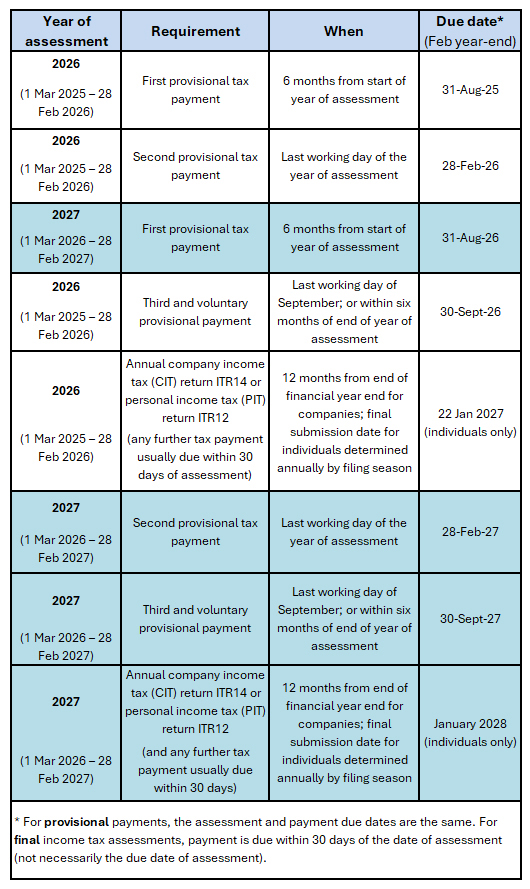
As a result, there are numerous deadlines that overlap across tax years. Yes: it is confusing, as the table below illustrates. But there’s no point throwing your arms up in the air: provisional tax non-compliance is met with some of the harshest penalties imposed by SARS.

Provisional and income tax timelines
Who are ‘provisional taxpayers’?

  • All companies except those specifically excluded
  • Any person who earns income which is not remuneration, an allowance or advance or who earns remuneration from an employer not registered for employees’ tax except those specifically excluded
  • A labour broker with an exemption certificate
  • Any person notified by the Commissioner of SARS

Why must provisional tax be paid?

Provisional tax payments are like instalments on taxpayers’ annual income tax, paid in advance and spread over two or three payments during the year. These payments are deducted against any tax owing after the year’s final income tax return is filed – at which point any further tax liability will then become due.

The objective is to prevent taxpayers from facing large income tax liabilities that are only revealed at the end of the year of assessment. 

How is provisional tax declared and paid?

  • Provisional tax payments are calculated on estimated taxable income, including current taxable capital gains, for that particular year of assessment.
  • The estimates, says SARS, must be determined sensibly and by careful reasoning and judgment, in a mathematical manner, and using experience, common sense and all available information.
  • The first period estimate is forward-looking, requiring companies to estimate their taxable income for the year ahead and then to pay tax on this estimate in advance.
  • In contrast, the second period provisional return is retrospective, since by the year-end there is more certainty regarding the income for the year, and the tax due thereon.
  • These estimates of taxable income are submitted to SARS on an IRP6 return, which must be submitted by all provisional taxpayers for the first and second periods.
  • Even if you or your company owes no tax, a ‘nil’ return showing taxable income is equal to zero must still be filed on time.
  • If an IRP6 is filed more than four months after the deadline, SARS considers a ‘nil’ return to have been submitted, and unless the actual taxable income is really zero, this will result in penalties.
  • Accurate records of all the calculations and source documents used must be kept as SARS can ask for the estimate to be justified and, if dissatisfied with the amount, increase the estimate.

Do call on our professional assistance

All taxpayers are ultimately responsible for their tax affairs, even though provisional tax is particularly daunting and confusing, with so many overlapping deadlines, complex requirements and harsh penalties.

Expert tax advice is highly recommended to ensure compliance with the requirements and the filing and payment deadlines. You know who to call.

Disclaimer: The information provided herein should not be used or relied on as professional advice. No liability can be accepted for any errors or omissions nor for any loss or damage arising from reliance upon any information herein. Always contact us for specific and detailed advice.

© AccountingDotNews

July 29, 2026
https://www.mfi.co.za/wp-content/uploads/2026/07/Provisional-Tax_650x300.png 300 650 MFI http://www.mfinc.co.za/wp-content/uploads/2023/09/cropped-cropped-MFI-Logo-Icon.jpg MFI2026-07-29 09:28:132026-07-29 13:07:21Provisional Tax Time: First Payment for 2027 Tax Year Due 31 Aug

Everyone Makes Them: Here’s How to Recover from a Bad Business Decision

Business

“Failure is simply the opportunity to begin again, this time more intelligently.” (Henry Ford)

Bad decisions are a near-universal leadership experience. A 2023 study of more than 14,000 employees and business leaders across 17 countries, commissioned by Oracle, found that 85 percent of business leaders have suffered from what the researchers called “decision distress” (regretting, feeling guilty about, or actively questioning a decision made) in the past year. The same study found that 72 percent of business leaders admitted they had, at some point, given up on making a decision altogether because the available data felt overwhelming. Decision-making, in other words, is hard for everyone.

What separates leaders who recover and grow from those who stall is not the absence of bad calls. It is the quality of their response.

Own it before it owns you

The most consistent thread running through research on leadership recovery is the importance of accountability. The instinct to go quiet or minimise the impact when a decision backfires is understandable, but it can also be expensive. Once an error is noticed, credibility is far harder to restore than it would have been had the leader simply spoken plainly from the outset. The fastest route to rebuilding trust is not spin, but ownership.

Diagnose the root, not just the symptom

The second step, and one that leaders under pressure are most tempted to skip, is genuinely understanding why the decision went wrong. Surface-level post-mortems, such as “we moved too fast”, or “we didn’t have enough data” only produce surface-level corrections. Durable improvement requires tracing the failure back to its actual structural cause. Was it a flawed decision-making process? Groupthink? A blind spot about the customer? Or an incentive structure that rewarded the wrong behaviour?

Denis Liam Murphy, leadership consultant and author of The Blame Game, argues that leaders need to develop what he calls “real-time hindsight”, the discipline of reflecting immediately and honestly on what a decision revealed, rather than waiting for a formal review cycle.

The Schultz playbook: Structural recovery at scale

When Schultz returned to Starbucks as CEO in January 2008, he inherited the consequences of decisions made during a period of aggressive over-expansion. The company’s stock had declined approximately 70 percent from its 2006 peak, and 600 stores were closed across 2008 and 2009. As a Harvard Business School case study on the turnaround later documented, Starbucks had drifted from the core identity that had made it successful: the experience, the craft, and the culture.

Schultz’s recovery was not built on a single dramatic gesture. It was built on a systematic return to first principles: closing 7,100 US stores for a single afternoon in February 2008 to retrain baristas, investing in the quality of the product, and making a deliberate, public commitment to slowing down in order to grow sustainably. The recovery that followed became a business school case study not because the error was unusual, but because the response to it was disciplined, transparent, and impactful in a way that resonated with the customer base.

Build the lesson into the system

The next step in the process is to build the mechanisms which help prevent mistakes from going too far into the system. This means creating what practitioners sometimes call a “failure loop”, a deliberate process for reviewing decisions, documenting what was learned, and feeding those lessons back into future decision-making frameworks.

The practical application for any business is straightforward: after a significant misstep, write down what happened and what should have been done differently. Share it with the team. Make the lesson available to the organisation, not just the person who made the call.

Resilience is not indifference

All this advice comes with a warning. Once making errors becomes consigned to a system, it opens up the possibility of leaders accepting errors as common, processing them efficiently and therefore, becoming indifferent to their impacts. On the surface this can look like emotional stoicism, but that is neither realistic nor effective. Obviously, mistakes should be avoided at all costs.

Murphy’s research points to three foundations of genuine leadership resilience: psychology, self-care, and a support network. The first is the capacity to frame struggle as information rather than verdict. The second is giving yourself the actual time and space to recover. The third is having people around you who will tell you the truth.

None of that is soft advice. The studies show that a leader who burns through a failure without adequately processing it is actually more likely to repeat it. The goal is not to feel nothing, but to feel clearly, learn quickly, and move with intention.

Disclaimer: The information provided herein should not be used or relied on as professional advice. No liability can be accepted for any errors or omissions nor for any loss or damage arising from reliance upon any information herein. Always contact us for specific and detailed advice.

© AccountingDotNews

July 29, 2026
https://www.mfi.co.za/wp-content/uploads/2026/07/bad_decisions_650.png 300 650 MFI http://www.mfinc.co.za/wp-content/uploads/2023/09/cropped-cropped-MFI-Logo-Icon.jpg MFI2026-07-29 09:09:512026-07-29 09:09:51Everyone Makes Them: Here’s How to Recover from a Bad Business Decision

The Subscription Trap: SMEs are Losing Thousands to “SaaS Creep”

Business

“SaaS spend increases without founders noticing because subscriptions renew automatically, ownership is unclear, and usage is rarely reviewed as teams change.” (Michael Pantilione)

From communication channels, to shared workspaces, AI chatbots and design services, companies are aware that they are paying more for monthly subscriptions than ever before. Research, however, suggests that most firms have no idea how deep the problem goes.

The Zylo 2026 SaaS (Software as a Service) Management Index reported that the average large organisation manages 305 separate software applications. Forty-six percent of those licences sit unused at any given time, representing approximately $19.8 million in wasted annual expenditure for the average enterprise. And it’s not just a problem affecting larger businesses. According to the report, the average British SME is estimated to waste as much as R250 000 a year on software that isn’t being actively used.

These figures reflect more than careless purchasing decisions. They are a predictable consequence of how cloud software is designed to be sold, distributed, and renewed. SaaS vendors have built their distribution models around frictionless adoption and auto-renewals. For organisations that lack formal governance over their software portfolios, this dynamic produces a cost base that grows by default, irrespective of whether the tools in question are delivering measurable business value.

Why oversight fails

The central driver of SaaS creep is decentralisation. Over the past decade, purchasing authority for software has migrated steadily away from IT and finance functions and towards individual business units. The Zylo 2026 SaaS Management Index found that business units now control 81% of total SaaS spend, while IT departments directly manage just 15%. In a small business, where procurement processes are typically informal and financial controls on software purchasing are loosely enforced, this dynamic is even more pronounced.

In short, no single department maintains visibility across the full portfolio. The Marketing team acquires its own tools, Operations purchases its own platforms, and individual team members subscribe to productivity applications on corporate expense accounts. According to Productiv, approximately 48% of enterprise applications are effectively unmanaged, meaning no one in the organisation is tracking renewal dates or monitoring active usage.

Each purchasing decision is locally rational. But collectively, they produce a software stack which is almost impossible to fully understand, manage or audit.

The renewal mechanism

Automatic renewals compound the problem. SaaS vendors have no interest in identifying underutilised licences ahead of renewal as exercising the contractual right to reduce or cancel rests entirely with the buyer.

Are there solutions?

The only way of making sure you don’t become a victim of SaaS creep, is to take control of the issue and focus on visibility, ownership, and timing. Complete visibility means knowing every active subscription in the portfolio: what it costs, who authorised it, and whether it’s being used. As your accountants, we can help you conduct a full audit of subscriptions, and put together a list of just what’s being deducted and for which service. Once you know what you are subscribed to, you can decide what to keep and which to cull.

Following on from this, it’s vital to assign someone from each team to oversee subscriptions. This person needs to make the ultimate purchasing decisions, and must maintain a complete list of subscribed services. This way, subscriptions can become an element of employee onboarding and offboarding, ensuring nothing gets lost in the system and invisible renewal costs don’t pile up in the background.

The final word

SaaS creep is, at its root, an organisational design problem. It emerges predictably wherever purchases are not carefully monitored, and where auto-renewal clauses allow costs to persist beyond the point of value. For you as a business leader, the takeaway is simple: software spend requires the same disciplined oversight as any other cost.

Disclaimer: The information provided herein should not be used or relied on as professional advice. No liability can be accepted for any errors or omissions nor for any loss or damage arising from reliance upon any information herein. Always contact us for specific and detailed advice.

© AccountingDotNews

July 29, 2026
https://www.mfi.co.za/wp-content/uploads/2026/07/Subscription-trap650.jpg 300 650 MFI http://www.mfinc.co.za/wp-content/uploads/2023/09/cropped-cropped-MFI-Logo-Icon.jpg MFI2026-07-29 08:59:172026-07-29 08:59:17The Subscription Trap: SMEs are Losing Thousands to “SaaS Creep”

CIPC, SARS, UIF, COIDA … Our Expertise Makes Compliance Easier

Company / Corporate / Compliance

“Compliance is not a choice. It’s a responsibility.” (Jack Welch, former CEO, General Electric)

In South Africa, business compliance obligations are enforced by several different government bodies, each responsible for a different section of business oversight, and each with its own systems and requirements.

Compliance is a strategic business priority today, not only because it is essential to business success, but also because it is ongoing, extremely expensive, and increasingly complex.

Compliance is essential

Non-compliance with business regulations can trigger financial penalties, audits, being flagged as non-compliant by CIPC, rejected funding applications, and missed commercial opportunities.

Unpaid tax debt can be collected by SARS directly from a company’s bank account or another third party, like a client. Deregistration at CIPC means the company loses legal standing to contract, and this can result in, for example, the company’s bank account being closed by the financial institution. 

Compliance is ongoing

Compliance isn’t a once-off exercise. It’s an ongoing responsibility that evolves as your business starts interacting with banks, funders, clients, and regulators, employs staff, and generates more revenue.

Local businesses are subject to ever more regulatory obligations that are not only increasingly complex but also constantly changing, demanding ever more human and financial resources.

Compliance is so expensive

Compliance costs are substantial in South Africa, roughly three to five times higher than in similar countries, according to the Free Market Foundation. “Across an estimated 150,000 SMEs, the aggregate cost of compliance is estimated at R270 – 450 billion annually, equating to roughly 4 – 6% of GDP.”

The report continues: “For a medium-sized enterprise, direct compliance expenditures, including internal compliance staff, external advisors, licencing and filing fees, and reporting systems, range from R1.4 million to R3 million per year. When indirect costs (diversion of management time, lost strategic opportunities, risk mitigation activities) are included, the total annual burden may easily double.”

Compliance is for every business

For almost all businesses, essential compliance includes at the very least the requirements of the Companies and Intellectual Property Commission (CIPC), the South African Revenue Service (SARS) and the Department of Employment and Labour (DEL)

CIPC compliance: Annual returns and Beneficial Owner Registers

  • Registration: CIPC registers and maintains records of private companies (Pty Ltds) and close corporations (CCs) in South Africa.
  • Legal standing: CIPC compliance gives your business a legal registration number, recognition as a juristic person, the standing to contract with clients and institutions, and the ability to open a business bank account.
  • Annual returns: Every registered company must submit annual returns (and other documents) to CIPC within 30 business days of its registration anniversary to confirm the business is active and to disclose annual turnover. Beneficial Owner Registers must also be filed annually or when beneficial ownership changes occur.

Consequences of non-compliance include late filing penalties, being marked as a non-compliant company, and – after two consecutive years of non-submission – possible deregistration. Deregistration can invalidate contracts and result in bank accounts being frozen.

SARS: Tax compliance

  • Income tax: Companies are automatically registered for income tax when incorporated with CIPC, but compliance still requires submitting income tax returns annually, as well as provisional tax returns twice a year where applicable, while keeping accurate financial records and paying tax liabilities on time.
  • Employee taxes: From the day your first employee starts, and assuming the relevant criteria are met, employee income tax (PAYE), Unemployment Insurance Fund contributions (UIF), and the Skills Development Levy (SDL) must be declared and paid monthly via the EMP201 return.
  • VAT: VAT registration is mandatory once annual taxable supplies exceed R2.3 million in any 12-month period. Voluntary registration is allowed when taxable supplies exceed R120,000. VAT compliance typically means bi-monthly or monthly VAT201 submissions, accurate invoicing and strict record-keeping.

Tax non-compliance is one of the most common reasons businesses run into penalties, audits, or rejected funding applications, because many tenders, credit applications, and commercial contracts require proof of tax compliance in the form of a SARS TCS (Tax Compliance Status) PIN (Personal Identification Number).

DEL: Labour law compliance

  • Written employment contracts and policies aligned with the Basic Conditions of Employment Act (BCEA), the Labour Relations Act (LRA), the National Minimum Wage Act (NMW) and any applicable sectoral determinations are critical.
  • UIF registration is mandatory within 21 days after appointing the first employee who works at least 24 hours a month, using the DEL’s uFiling portal.
  • The COIDA (Compensation for Occupational Injuries and Diseases Act) requires registration with the Compensation Fund to provide workplace injury compensation. Businesses must submit an annual Return of Earnings (ROE) to the DEL, declaring employees’ earnings, even in years with no incidents, to keep the crucial Letter of Good Standing valid.

Labour law non-compliance is a common cause of audits, inspections, and penalties. In addition, missing a ROE submission can delay the company’s Letter of Good Standing, holding up tender participation, contracts, and even site access.

Compliance as a strategic strength

Compliance can be a strategic strength. Proactively managed compliance protects organisations from risk, improves access to funding, maintains eligibility for opportunities and partnerships, and enables your business to thrive responsibly.

We can assist you in all company compliance matters. Our expertise and years of experience will not only unlock all these benefits for you but will also save your company a great deal of time, hassle, and costs – now and in the long run.

Disclaimer: The information provided herein should not be used or relied on as professional advice. No liability can be accepted for any errors or omissions nor for any loss or damage arising from reliance upon any information herein. Always contact us for specific and detailed advice.

© AccountingDotNews

July 29, 2026
https://www.mfi.co.za/wp-content/uploads/2026/07/CIPC_650.png 300 650 MFI http://www.mfinc.co.za/wp-content/uploads/2023/09/cropped-cropped-MFI-Logo-Icon.jpg MFI2026-07-29 08:37:562026-08-04 08:27:33CIPC, SARS, UIF, COIDA … Our Expertise Makes Compliance Easier

Pages

  • About
  • Accounting and Banking
  • Careers
  • Careers-PTA01
  • Contact
  • Financial Planning
  • HOME
  • Latest News
  • Medical Practice Management
  • MFI Team
  • Testimonials

Categories

  • Accounting
  • Business
  • Company / Corporate / Compliance
  • DotNews
  • Economy
  • Employment and Labour
  • Employment and Labour Law
  • Financial
  • Investment
  • Tax
  • Technology
  • Trusts
  • Uncategorized
  • Wills and Estate Planning

Archive

  • July 2026
  • June 2026
  • May 2026
  • April 2026
  • March 2026
  • January 2026
  • November 2025
  • October 2025
  • September 2025
  • August 2025
  • July 2025
  • June 2025
  • May 2025
  • April 2025
  • March 2025
  • February 2025
  • January 2025
  • July 2023
  • June 2023
  • May 2023
  • April 2023
  • March 2023
Standard POPI Act Privacy Policy Statement

Scroll to top