MFI
  • HOME
  • About
    • About MFI
    • Testimonials
  • Services
    • Accounting and Banking
    • Financial Planning
    • Medical Practice Management
  • Contact
  • Careers
  • Latest News
  • Search
  • Menu Menu
  • Facebook
  • LinkedIn

6 Ways to Maximise Your Revenue Through Smarter Networking

Business

“Networking is not about just connecting people. It’s about connecting people with people, people with ideas, and people with opportunities.” (Michele Jennae, business coach and author)

Most entrepreneurs know they should be building a network, but not many know this should be a core business strategy. Building and maintaining the right relationships can lead to improved contracts, revenue gains and business growth, provided you know how to use them.

The good news is, we aren’t asking you to go out and become a natural networker. You just need to put a few key habits in place and start treating networking as a long-term business investment. Here are six common misconceptions that, when remedied, can help turn handshakes into business growth.

1. “I go to networking events, but I never see any benefits”

This is a common complaint, but it’s seldom the event that’s at fault. Many people see no benefits because they approach networking events passively. They show up, have a few chats, hand out business cards, and hope someone follows up. That’s not networking. That’s exposure. 

To make events pay off, you need to arrive with a goal, and steer conversations intentionally. Then afterwards, you need to follow up promptly. This doesn’t mean that you need to sell to everyone in the room. Often it’s far better to listen to people’s needs and identify just where you might be useful. A short, personalised follow-up message, the next day could then unlock a real business opportunity.

2. “I simply don’t have time to network”

Networking doesn’t have to be a drain on your time. If you’re chatting to the right people, just one or two strategic conversations a week might be all you need. The key is to start thinking of networking as business development – everyone has time for that.

If you can carve out 30 minutes a week to check in with past contacts, make introductions for others, or send a useful article to someone in your network, you’re already doing more than most. The results won’t be instant, but it all adds up.

3. “My industry doesn’t work like that”

Whether you’re in logistics, consulting, construction, or retail, your next deal could still come from a friendly introduction. The channel might differ, but the principle is the same. People do business with people they trust. That old saying, “it’s not what you know, but who you know” has never been truer. No industry is too technical or regulated for word-of-mouth not to matter.

4. “I’ve already got a good network”

Knowing people isn’t enough. That network of people needs to be activated. This means that you need to make yourself visible, helpful, and memorable. Stay top-of-mind by making introductions, sharing your insights, or simply checking in without hoping to make a sale. The goal isn’t to extract value, it’s to keep yourself fresh in their minds so you’re the first person they think of when they do need something.

And remember: relationships decay over time, so make sure you refresh them regularly.

5. “Networking doesn’t feel authentic”

Networking should never feel like a performance. The most effective networkers aren’t slick or rehearsed. They listen more than they talk. They ask thoughtful questions. If you’re having no luck networking, it may be because you’re trying too hard to be interesting, rather than simply being interested.

Shift the focus. Stop trying to pitch, and start looking for ways to be useful. Can you make an introduction? Offer advice? Share a resource? That’s where trust starts and a true network can develop.

6. “I don’t see how this makes me money”

Networking contributes directly to revenue by opening access to people and opportunities you wouldn’t reach on your own. The referrals you get from people you have met and been valuable to, will often lead to new business.

The bottom line

There’s no need to “become a networking expert,” but there is a need to focus on a few strategic relationships. Show up with intent. Follow up with purpose. And above all, give before you ask. The returns might not be instant, but they will come.

Ask us if you aren’t sure how much room you have in your marketing budget for networking activities.

Disclaimer: The information provided herein should not be used or relied on as professional advice. No liability can be accepted for any errors or omissions nor for any loss or damage arising from reliance upon any information herein. Always contact us for specific and detailed advice.

© AccountingDotNews
July 29, 2025
https://www.mfi.co.za/wp-content/uploads/2025/07/Smarter_Networking_650.jpg 300 650 MFI http://www.mfinc.co.za/wp-content/uploads/2023/09/cropped-cropped-MFI-Logo-Icon.jpg MFI2025-07-29 12:57:572026-03-13 07:50:426 Ways to Maximise Your Revenue Through Smarter Networking

Don’t Let Your Best Ideas Go: Why You Must Protect Your Intellectual Capital

Business

“Too many businesses only realise the value of intellectual capital when a key person leaves – or a competitor copies what they’ve built.” (Alicia Mendes, author of Futureproofing Through People)

In the rush to raise capital, improve profitability or streamline efficiency, business owners often miss what truly drives their success: the knowledge, relationships, and systems that power everything behind the scenes.

Whether you’re a one-person start-up or a growing enterprise, your intellectual capital is the secret key to your future triumphs. It is therefore vital that this intangible resource is protected before it vanishes. Doing so could be the most profitable decision you ever make.

Understanding intellectual capital

Intellectual capital is grouped into three categories: human capital (skills and experience), structural capital (systems, intellectual property (IP), databases) and relational capital (customer relationships, brand reputation and partnerships). 

A recent study by Ocean Tomo revealed that intellectual capital now constitutes approximately 90% of the S&P 500’s market value – a significant increase from 68% in 1995. That includes patents, know-how, trade secrets, brand equity, and team knowledge.

With numbers like this, it’s absolutely essential that you audit your intellectual capital just as you would your balance sheet. What processes are unique to you? Who on your team holds key relationships or institutional memory? Are your best ideas captured anywhere, or do they leave when someone resigns?

Culture and contracts

You have to understand that your people are the carriers of knowledge. Their experience, relationships with clients, and systems know-how can be invaluable. Unless you plan carefully, when someone leaves they often take that intellectual capital with them. 

Retention doesn’t just come from compensation. It comes from fostering a culture of recognition, curiosity, and inclusion. The 2023 Gallup “State of the Global Workplace Report” stated that, “employees who have had opportunities to learn and grow are 2.9 times more likely to be engaged.” It is therefore essential that you ask your accountant to make space in your budget for learning programs, and other leadership developing initiatives. 

But culture alone isn’t enough. It’s important to also back up your culture with a legal framework that protects you. This includes NDAs (non-disclosure agreements), IP assignment agreements, and clear clauses in employment contracts covering confidentiality and ownership of work.

Capture knowledge before it walks

Most businesses operate through a web of undocumented processes from verbal know-how, to “we’ve always done it this way” workflows. That’s risky.

Developing internal playbooks, knowledge bases, and SOPs (standard operating procedures) is one of the most effective ways to turn intellectual capital into something transferrable and scalable.

Use tools like Notion, Confluence, or even simple shared drives to document repeatable knowledge. Then embed this into your onboarding and training cycles.

Nurture innovation and learning

Intellectual capital isn’t static. Like any asset, it can appreciate or depreciate. One of the best ways to nurture it is by creating space for learning, experimentation, and cross-pollination of ideas. 

Encourage teams to attend industry events, run internal hackathons, and allocate budget to learning and development. Even better, reward creative problem-solving that moves the business forward.

Make intellectual capital part of your valuation

It’s vital that your intellectual capital becomes a cornerstone of your company valuation. Whether you’re pitching to investors, selling your business, or applying for funding, it’s important that you document your competitive advantages. Have you built a repeatable system others can’t match? Developed internal tools that boost efficiency? Retained staff with rare skills? All of this translates into value.

Only by showing how your business can thrive even if the best individuals leave, can you give future investors the knowledge they need to trust you.

Protect what really drives value

Tangible assets can be insured. Cash can be raised. But your intellectual capital requires conscious attention and care. Whether you’re building your first business or scaling your fifth, now is the time to treat your brainpower like the goldmine it is.

Disclaimer: The information provided herein should not be used or relied on as professional advice. No liability can be accepted for any errors or omissions nor for any loss or damage arising from reliance upon any information herein. Always contact us for specific and detailed advice.

© AccountingDotNews

June 26, 2025
https://www.mfi.co.za/wp-content/uploads/2025/06/0812c8db-9c99-4bee-9c8a-9a3cbfc6ffb1.jpg 300 650 MFI http://www.mfinc.co.za/wp-content/uploads/2023/09/cropped-cropped-MFI-Logo-Icon.jpg MFI2025-06-26 10:50:252026-03-13 07:51:07Don’t Let Your Best Ideas Go: Why You Must Protect Your Intellectual Capital

Business Hack: How to Better Define Your Target Market

Business

“Defining your target market is about understanding motivations, challenges, and goals. Without this, your messaging falls flat and your marketing budget burns fast.” (Elena Kwan, Founder of MarketLens Consulting)

Fundamentally, businesses start because business owners believe they see a gap and aim to fill it. Their target market is built into the essence of the business. And yet, statistics show that at least one third of those business owners were wrong all along.

Many entrepreneurs think their product or service is for “everyone”, but trying to serve everyone usually means you end up serving no one well. Identifying and refining your real audience is critical to creating effective marketing campaigns, building better products, and sustaining long-term growth.

Here are five practical tips to help you better define and refine your target market.

1. Start with the problem you’re solving

As a business owner, the first thing you need to do is identify the specific problem your product or service addresses. Ask yourself: Who has this problem? Who is actively looking for a solution? The more precisely you can answer these questions, the closer you are to identifying your core market.

Once you understand the problem, look at existing customer data or run surveys to determine the people most likely to benefit from your solution. Don’t make assumptions. Focus on the why behind their purchasing decisions.

2. Build a customer persona (and revisit it often)

A customer persona is a semi-fictional profile of your ideal customer based on research, data, and interviews. Include details like age, job title, income, goals, frustrations, preferred social media platforms, and buying behaviours. Giving your customer a name and a story will help you recall the important aspects of the person you are serving.

But remember, a persona isn’t static. As you grow and collect more data, revisit and refine this profile. According to Sales For Startups, companies that use updated personas achieve 73% higher conversion rates than those that don’t.

3. Segment your audience

Not every customer will have the same needs or behaviours – and just because someone falls into your target market, doesn’t mean they are automatically going to buy from you. Audience segmentation allows you to create more tailored marketing strategies. Start with basic segments like age, location, or purchase behaviour. Then drill down into psychographics such as values, attitudes, and lifestyle.

For example, two people buying your eco-friendly cleaning product might do so for different reasons: one for health reasons, the other out of environmental concerns. Understanding these motivations enables you to craft more resonant messaging.

4. Use analytics to refine your focus

Data should drive your decisions. Use website analytics, social media insights, email open rates, and CRM (customer relationship management) data to understand who’s engaging with your content, who’s buying, and who isn’t. Look for patterns: Which landing pages convert best? Which demographic clicks through the most?

Your accountant can help you lift accurate sales data for different periods. This can be used to track the success or failure of special offers, product launches and other sales events to narrow down the areas that are working.

According to a survey by Salesforce, 76% of marketers say data-driven decision-making is crucial in campaign performance. By comparing your ideal audience to actual customer behaviour, you can adjust your messaging or target more profitable segments.

5. Actually talk to your customers

The most underrated source of insight is your customers themselves. Schedule interviews, send out surveys, or talk to users after a successful sale. Ask open-ended questions like:

  • “Why did you choose us?”
  • “What alternatives did you consider?”
  • “What almost stopped you from buying?”

These conversations will undoubtedly uncover objections you hadn’t considered, new segments you didn’t plan for, or even product ideas for future growth. And remember: customers are often more honest in conversation than on email.

The bottom line

Defining and refining your target market isn’t a once-off job. It’s an ongoing process that evolves as your business, market conditions, and customer needs change. But investing the time upfront, and revisiting it regularly, can mean the difference between scattered sales and scalable success.

If you need help understanding your sales data, speak to us.

Disclaimer: The information provided herein should not be used or relied on as professional advice. No liability can be accepted for any errors or omissions nor for any loss or damage arising from reliance upon any information herein. Always contact us for specific and detailed advice.

© AccountingDotNews

June 26, 2025
https://www.mfi.co.za/wp-content/uploads/2025/06/e5f49767-9a18-4ecc-9889-e5c429b297d6.jpg 300 650 MFI http://www.mfinc.co.za/wp-content/uploads/2023/09/cropped-cropped-MFI-Logo-Icon.jpg MFI2025-06-26 10:07:332026-03-13 07:51:07Business Hack: How to Better Define Your Target Market

5 Tips for Helping Your Employees Through a Crisis

Business

“When people are financially invested, they want a return. When people are emotionally invested, they want to contribute.” (Simon Sinek)

Employee engagement. It determines so much about the direction of a company, its staff productivity and how likely it is to succeed. According to a Gallup poll just 23% of South African employees are actively engaged, and the support offered by your company during difficult times is a key predictor of whether your employees are doing better or worse than that. Ignoring a personal crisis or mismanaging it can result in diminished trust, high turnover, and costly legal complications. On the other hand, getting it right can transform a tough moment into a team-building exercise that drives loyalty across your enterprise. Here are our five tips for handling an employee’s crisis with care, compassion, and professionalism.

1.  Listen without judgement

The first step in supporting someone through a crisis is simply to listen. Not all employees will be forthcoming, and many will fear repercussions or shame if they do share. By creating a psychologically safe environment where they feel heard and respected, you allow the conversation to unfold in a way that will allow you to help.

Listening does not mean solving. Ask what they need. Avoid overpromising or reacting too quickly. This is their experience, not yours, and your job is to provide space for them to express it.

2.  Tailor your support to the individual

There is no one-size-fits-all approach. While one employee might benefit from time off, another may prefer flexible hours or a change in responsibilities. Consider what reasonable accommodations can be made, in accordance with HR policies and employment laws. What’s important is that the support feels personal and meaningful, not generic or performative. You will likely want to speak to HR or, in a smaller business, ask for outside advice.

3.  Communicate clearly (and privately)

When an employee’s going through emotional turmoil, one of the most challenging aspects is managing the line between transparency and confidentiality. While you may need to inform certain stakeholders about changes in workflow or responsibilities, the nature of an employee’s crisis should never be discussed openly or speculated about in the office.

Establish clear, private channels of communication and check in regularly. Let the employee know what’s being shared and with whom – and always ask for their consent where appropriate. Trust is fragile and you need to protect it.

4.  Support your other employees too

It’s not just the employee in crisis who needs help – often their direct manager, or co-workers will also be feeling overwhelmed, overworked or unsure how to proceed. Offering management training on crisis response, mental health first aid, and compassionate communication can improve outcomes for everyone involved.
Managers are on the front line of employee wellbeing, and giving them the right tools helps avoid missteps that could escalate the situation.

5.  Make room in your budget for empathy

There’s no denying that crisis support can come with financial implications, from offering extra leave to making temporary hires to cover the missed workloads and even therapy for the staff member. But investing in your people always pays off in the long run. This is where your accountant becomes more than a numbers person. 

A good accountant can help you identify inefficiencies, reallocate budget, and plan for contingency resources that empower your company to care for its people without compromising its financial goals. 

Lead by example

Your response to employee hardship is a reflection of your company’s values in action. Whether you’re a five-person startup or a 500-person corporation, prioritising empathy in moments of crisis can leave a lasting legacy of loyalty, leadership, and integrity.

If you need help freeing up some “empathy budget”, speak to us.

Disclaimer: The information provided herein should not be used or relied on as professional advice. No liability can be accepted for any errors or omissions nor for any loss or damage arising from reliance upon any information herein. Always contact us for specific and detailed advice.

© AccountingDotNews

May 28, 2025
https://www.mfi.co.za/wp-content/uploads/2025/05/9f7f93f8-fe5c-4e97-91e6-8db9d556aeb1.jpg 300 650 MFI http://www.mfinc.co.za/wp-content/uploads/2023/09/cropped-cropped-MFI-Logo-Icon.jpg MFI2025-05-28 09:03:442026-03-13 07:51:075 Tips for Helping Your Employees Through a Crisis

Youth Day: How Businesses Can Benefit from the ETI

Business

“Trust the young people; trust this generation’s innovation. They’re making things, changing innovation every day.” (Jack Ma, Co-Founder Alibaba Group)

South African businesses are always looking for ways to foster growth and innovation while still reducing costs.   

One way to achieve both is to employ young people. Young workers bring unique advantages that can transform your organisation. What’s more, the government subsidises part of the employment costs for qualifying young employees through SARS’ Employment Tax Incentive or ETI. 

What young employees can bring to your business
  • Tech savvy: More comfortable with new technologies, young employees can accelerate digital adoption in your business.
  • Fresh perspectives: Young employees often introduce innovative approaches and creative solutions.
  • Adaptability: Young people tend to be more flexible and better equipped to respond to sudden changes and unexpected circumstances.
  • Fast learning: Fresh out of formal education, young people often learn more readily and are eager to apply their skills.
  • Energy and enthusiasm: The energy and optimism of younger workers can positively impact team dynamics and workplace morale.
  • Future-proofing: Young employees help businesses keep up to date with technological developments, emerging trends and the millennial and Gen Z markets.
How the ETI benefits local companies

The ETI makes it more cost-effective for companies to employ young people and to harness all the benefits mentioned above.

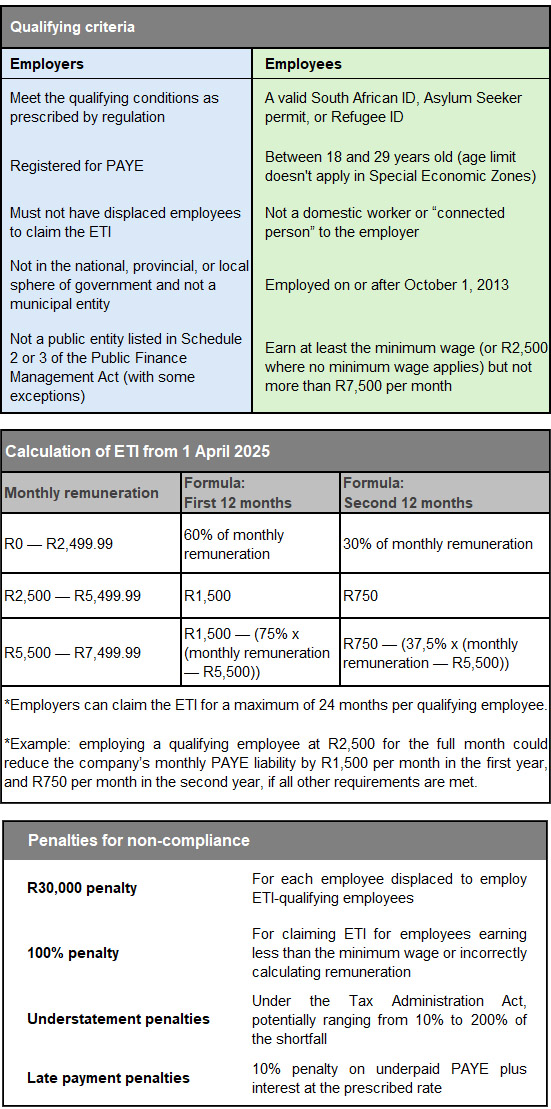
Essentially, this incentive subsidises part of your employment costs for qualifying young employees for two years. There is no limit to the number of qualifying employees that an employer can hire.

The young employees’ wages are paid by the employer in full, and the ETI is claimed by reducing the employer’s monthly Pay-As-You-Earn (PAYE) liability by the calculated ETI amount. This creates immediate positive effects on your cash flow.

It goes without saying that hiring more employees at a lower cost – and the boost of youthful energy they bring – will positively impact productivity and innovation in any company. Many South African businesses use the ETI to create a competitive advantage, build a talent pipeline for the future, and enhance their Corporate Social Responsibility credentials.

How the ETI works  


* Adapted from SARS 

Common ETI pitfalls
  • Claiming for non-qualifying employees
  • Incorrectly calculating ETI amounts
  • Failing to adjust claims after the 12-month threshold
  • Not maintaining proper payroll records 
  • Overlooking the ‘monthly remuneration’ definition and required adjustments.
How professional assistance makes a difference

The ETI offers significant benefits, but it also comes with considerable compliance requirements and potential penalties for incorrect implementation.

Our team of experienced accountants and tax professionals stays up to date with the ever-changing regulations, uses professional systems to identify qualifying employees, accurately calculate claims, and keep proper records, and is ready to assist if any issues, compliance checks or audits arise. 

In this way, we ensure your business can maximise the ETI benefits – and the benefits of having young employees – while minimising compliance risks.

Speak to us if you need help taking advantage of the ETI.

Disclaimer: The information provided herein should not be used or relied on as professional advice. No liability can be accepted for any errors or omissions nor for any loss or damage arising from reliance upon any information herein. Always contact us for specific and detailed advice.

© AccountingDotNews

May 28, 2025
https://www.mfi.co.za/wp-content/uploads/2025/05/143ce16f-9a81-42a6-bacc-f20b355c0a0f.jpg 300 650 MFI http://www.mfinc.co.za/wp-content/uploads/2023/09/cropped-cropped-MFI-Logo-Icon.jpg MFI2025-05-28 08:59:172026-03-13 07:51:07Youth Day: How Businesses Can Benefit from the ETI

Budget 3.0: VAT Increase Out, Fuel Levy Hikes In

Business, Economy, Financial, Tax

Last month’s Budget 3.0 withdrew the contentious proposed VAT changes. This resulted in inflation-linked fuel levy increases of 16c for petrol and 15c for diesel, from 4 June.

Other tax proposals from March’s Budget – including static personal tax thresholds, reduced transfer duties, and sin tax increases – remain unchanged.

The tax measures contained in Budget 3.0 will raise an additional R18bn in 2025/26. A further R20bn in tax measures are postponed to Budget 2026 – unless SARS collects an extra R35bn in uncollected taxes, for which Budget 3.0 allocated an additional R4bn in funding.

Disclaimer: The information provided herein should not be used or relied on as professional advice. No liability can be accepted for any errors or omissions nor for any loss or damage arising from reliance upon any information herein. Always contact us for specific and detailed advice.

© AccountingDotNews

May 28, 2025
https://www.mfi.co.za/wp-content/uploads/2025/05/ebb63f62-a2e7-4562-a206-2fe262d437b6.jpg 300 650 MFI http://www.mfinc.co.za/wp-content/uploads/2023/09/cropped-cropped-MFI-Logo-Icon.jpg MFI2025-05-28 08:49:282026-03-13 07:51:07Budget 3.0: VAT Increase Out, Fuel Levy Hikes In

The 5 Cognitive Biases That Could Sink Your Business

Business

“Too often we hold fast to the clichés of our forebears. We subject all facts to a prefabricated set of interpretations. We enjoy the comfort of opinion without the discomfort of thought.” (John F. Kennedy, former US president)

Humans are creatures of habit. We form opinions and sets of actions that we use as shorthand for all future decisions. We become trapped in loops of our own making and fall prey to common human ways of thinking that may save time, but ultimately hurt us. In business, these sorts of cognitive biases can damage relationships, and lead companies down dangerous paths. The sad thing? Most of us don’t even realise they exist. Here are five cognitive biases that could sink your business if you’re not careful.

1.  Favouring evidence that backs our beliefs

Back in the days of VHS, video rental behemoth Blockbuster was offered the opportunity to buy a start-up that distributed their videos by mail, and were building the infrastructure to stream videos online. Convinced that the video store model was the only way to go, the board rejected the opportunity to purchase Netflix and over the next few years Blockbuster went bankrupt.

While it’s tempting to see this as a sign of foolishness, the reality is that all of us are prone to undervaluing data which contradicts our beliefs and favouring that which reinforces it. These confirmation biases can only be overcome by actively seeking out disconfirming evidence and encouraging a culture of robust debate among your employees.

2.  Doggedly holding the line

In 2008, signs began to leak out across the American economy that a large collapse was coming. Banks were overextended and the money from loans was not being returned fast enough – but many large businesses held the line and did not prepare for failure. The information they’d been given for years suggested the loans model worked and they did not adjust their behaviour as the data first trickled, and then thundered in. The result? An economic collapse for the ages.

A 1974 study by Tversky and Kahneman explains their decision making with the anchoring bias. This study showed that even when presented with later information, people’s numerical estimates were significantly influenced by irrelevant initial figures. The first information is given much more weight than later information, even if the later information comes from stronger sources. Luckily this bias is easy to overcome, by simply distrusting the early data – always compare it carefully with what comes later.

3.  Too much self-belief

Convinced their market dominance would carry them through, and unimpressed with the new digital cameras, photographic film manufacturer Kodak continued business as usual in the early 2000s. Despite their position as market leader and an early pioneer, these decisions lead to their eventual complete collapse. Kodak is a clear example of the overconfidence bias, which Bazerman and Moore detailed in their book Judgement in Managerial Decision Making. 

Overconfidence bias is our very human tendency to overestimate one’s own knowledge, skills, or the accuracy of one’s predictions. In business, this can manifest in risky decisions, such as under-pricing products, over-leveraging debt, or ignoring potential competitors. To overcome this, regularly schedule sessions to evaluate your decisions against the data, and seek outside advice from your accountants and other experts.

4.  Don’t follow the Joneses

Anyone who was alive in the 1990s remembers the Dotcom bubble. Tech companies were absolutely flooded with investment, with little care for the fundamentals from those who were convinced that tech’s bright future would lead to their own financial success. When the bubble burst in the early 2000s, many of those investors found themselves without a penny to their names.

The Dotcom bubble is an example of what’s known as the herd mentality. It describes a cognitive bias in which people have a tendency to mimic the actions of the masses, even against their own better judgement or personal logic. The rule here is simply: don’t do something just because everyone else is doing it. Never blindly follow trends. 

This comes with a caution though – while copying others for the sake of it is a bad idea, don’t fall into the trap demonstrated by Sears either. The former retail giant exhibited loss aversion bias by clinging to its traditional brick-and-mortar model and resisting e-commerce expansion for years – ultimately resulting in it filing for bankruptcy in 2018.

5.  Place the blame correctly

In 2008 Lehman Brothers was possibly the largest casualty of the economic collapse. Where many other financial institutions managed to keep their heads above water, Lehman Brothers sank below the waves. Unlike their more successful peers, Lehman Brothers had attributed all of their woes to the external factors of the economic collapse and failed to recognise the company’s own risky investments and poor decision-making as contributing factors.

This error is commonly known as attribution bias. In 2014, Mallett and Monteith explored attribution bias in business settings, showing that leaders often misattribute their company’s failures to external forces, preventing them from identifying areas for improvement. You can avoid this by promoting self-awareness and accountability. Don’t be afraid of asking experts for their input and always encourage regular post-mortems on projects to identify both internal and external factors contributing to their success or failure.

One of the best ways of overcoming biases is to get objective advice from external sources. As your accountants we can offer an important perspective – our door is always open!

Disclaimer: The information provided herein should not be used or relied on as professional advice. No liability can be accepted for any errors or omissions nor for any loss or damage arising from reliance upon any information herein. Always contact us for specific and detailed advice.

© AccountingDotNews

April 24, 2025
https://www.mfi.co.za/wp-content/uploads/2025/04/bias_650-1.png 300 650 MFI http://www.mfinc.co.za/wp-content/uploads/2023/09/cropped-cropped-MFI-Logo-Icon.jpg MFI2025-04-24 06:23:032026-03-13 07:51:07The 5 Cognitive Biases That Could Sink Your Business

This Workers’ Day, Look After Your Business’ Greatest Asset

Business, Employment and Labour

“Clients do not come first. Employees come first. If you take care of your employees, they will take care of the clients.” (Richard Branson)

Whether you call it May Day, Labour Day or International Workers’ Day, 1 May is an opportune time for businesses to consider and prioritise their workers. 

Here’s why happy workers are a business’s greatest asset (and some ways to foster a happier workforce).  

Business benefits of happy workers 
  1. Increased productivity. Various studies have shown that happy workers are more committed to company goals and up to 13% more productive.
  2. Improved customer service. People who are happy at work provide better customer service, leading to higher customer satisfaction and loyalty. 
  3. Reduced costs. Lower absenteeism and improved worker retention mean substantially reduced labour costs.
  4. Enhanced creativity and innovation. Happy workers buy into the big picture, offer creative solutions, take thoughtful risks, collaborate and are more likely to experiment. 
  5. Superior business performance. Gallup research shows that companies with happy workers can outperform competitors by up to 200%, and achieve up to 22% higher profitability.  
5 ways to increase happiness in your workplace
  1. Create a supportive work environment
    Essential for employee wellbeing is a safe and supportive work environment in which diversity is valued and everyone is included and treated respectfully. This is also the foundation for a company culture that’s centred around teamwork, collaboration, job satisfaction, and accomplishment.
  2. Balance job demands with resources
    Providing sufficient and appropriate resources to ensure staff can meet their work demands means the work gets done efficiently and on time. It is also important that workers’ roles and responsibilities are clear and aligned with company goals, and that issues like time pressures and overwhelming workloads are addressed quickly.
  3. Offer competitive compensation and benefits
    Be sure to offer fair compensation packages as well as benefits that add value to employees, such as flexible scheduling and work arrangements, extra paid time off or even an onsite canteen, gym, or creche. Maintain this competitiveness through annual compensation reviews.
  4. Recognise and appreciate all workers
    It can be a really good idea to implement a formal recognition programme. After all, over 70% of employees say “feeling unappreciated” is the biggest driver of dissatisfaction. It’s equally important to make health and wellbeing a priority in your workplace and to encourage workers to share their feedback, ideas and concerns. Nobody likes to feel ignored!
  5. Invest in professional development
    Continuously provide the necessary training and tools for employees to perform effectively. Complement this by investing in professional development, and offering workers at all levels opportunities for upskilling and career advancement.
The bottom line 

There is a real return on an investment in happy workers – and many easy ways to increase the level of happiness and engagement among your workers.

Call on us to assist with calculating optimal compensation packages and to provide financial and tax advice as you invest in your workforce’s wellbeing and happiness.

Disclaimer: The information provided herein should not be used or relied on as professional advice. No liability can be accepted for any errors or omissions nor for any loss or damage arising from reliance upon any information herein. Always contact us for specific and detailed advice.

© AccountingDotNews

April 24, 2025
https://www.mfi.co.za/wp-content/uploads/2025/04/employees_650.png 300 650 MFI http://www.mfinc.co.za/wp-content/uploads/2023/09/cropped-cropped-MFI-Logo-Icon.jpg MFI2025-04-24 06:02:092026-03-13 07:51:07This Workers’ Day, Look After Your Business’ Greatest Asset

Zen and the Art of Fostering Job Stability in an Uncertain World

Business, Employment and Labour, Uncategorized

“The more tranquil a man becomes, the greater is his success, his influence, his power for good.” (James Allen) 

The world of work has never felt less stable. Between high unemployment rates, a quicksand political environment, the gig economy and the introduction of new disruptive technologies (and tariffs!) almost daily, it’s no surprise that recent studies are showing people in 9-to-5 jobs no longer feel stable. A study by MyPerfectResume in 2024 found that four out of every five workers were afraid they may lose their jobs in 2025 due to technological advancements such as automation, artificial intelligence, and outsourcing. This was reinforced by the pandemic, when vast numbers of people were retrenched or otherwise lost their jobs. 

This uncertainty is affecting the mental health of modern workers. And it’s lowering productivity and impacting businesses, creating a vicious cycle of instability. According to the Journal of Occupational Health Psychology, workers who feel insecure about their jobs report higher levels of burnout, less job satisfaction, and lower engagement levels. When workers are constantly worried about being let go, it typically affects their focus, creativity, and long-term commitment to their employer. 

But does it have to be this way? Here are our tips for making your employees comfortable, more stable and ultimately, happier.

Honesty is the best policy

A little communication has been shown to go a long way to keep a workforce happy. Regular updates about company performance, future prospects, and any potential restructuring plans can help employees feel more in control and less fearful of unexpected layoffs. The Harvard Business Review (2020) found that organisations that maintain open lines of communication during times of uncertainty are able to reduce employee anxiety and build trust.

Teach a man to fish

Even if things are uncertain for your company, you should do your best to help upskill your employees and train them in new and exciting technologies. Focusing on continuous learning sends a strong signal that your company understands the modern environment and is planning for it. This doesn’t just lessen stress it also helps employees to feel that even if they are retrenched, they will still be well positioned to find new work. 

Your business will benefit too: the World Economic Forum suggests that employers who provide opportunities for skill development, including training in new technologies and leadership, are more likely to retain talent and maintain higher levels of employee morale. What’s more, training staff can lead to tax incentives. Speak to your accountant (that’s us) if you aren’t already taking advantage of these breaks.

B is for balance

It may sound counter-intuitive, but hybrid work models are repeatedly being shown to be an effective way to boost employee morale and lower the stress related to job loss. A 2022 report by Gallup found that employees who have more flexibility in how, when and where they work are more satisfied with their jobs and feel more secure in their roles. A quantum workplace study found that 89% of employees were looking for hybrid or remote work. Having control over their lives in this area gives employees the confidence and mental stability they need to handle other stresses so they can deliver better at work. 

Show the way

Job insecurity often stems from the fear that an employee’s current job offers no opportunities for advancement. A study by The Conference Board in 2018 showed that employees who are offered mentorship, leadership training, and a clear pathway to promotion are more likely to stay committed and engaged. Knowing that they are being eyed for future roles gives them the assurance that they won’t be first on the chopping block when the tough times arrive. 

If any of these initiatives are beyond your current budgets, speak to us about helping you restructure your finances. After all, retaining good employees is much cheaper than trying to find new ones. 

Disclaimer: The information provided herein should not be used or relied on as professional advice. No liability can be accepted for any errors or omissions nor for any loss or damage arising from reliance upon any information herein. Always contact us for specific and detailed advice.

© AccountingDotNews

April 24, 2025
https://www.mfi.co.za/wp-content/uploads/2025/04/zen_650.png 300 650 MFI http://www.mfinc.co.za/wp-content/uploads/2023/09/cropped-cropped-MFI-Logo-Icon.jpg MFI2025-04-24 05:56:082026-03-13 07:51:07Zen and the Art of Fostering Job Stability in an Uncertain World

Budget 2025: How It Affects You and Your Business

Business, Economy, Financial, Tax

“… the economy needs to grow much faster and in an inclusive manner. This is the central objective of the current administration.” (Finance Minister Enoch Godongwana – Budget 2025)

The tabling of Finance Minister Enoch Godongwana’s fourth Budget in February was marked by an unprecedented three-week postponement, following a deadlock around the original Budget proposal to increase VAT by 2%.

A revised Budget, finally tabled on 12 March, proposed a 0.5% increase from 1 May 2025, with a second 0.5% VAT increase from 1 April 2026 – but the proposal was still not enough to satisfy most other political parties.

In his Budget Speech, the finance minister called the Budget proposals “a bold and pragmatic approach” to ensure the economy grows “much faster and in an inclusive manner”. He admitted that the economy has stagnated for over a decade, with GDP growth averaging less than 2%, while forecasts for medium-term GDP growth are a dismal 1.8%.

While the powers that be attempt to reach consensus on the Budget 2025 proposals, businesses and individuals in South Africa will find little support from the fiscus to survive these low-growth economic conditions. 

This is evident from our overview below of the most pertinent Budget 2025 proposals. In a nutshell, the finance minister is trying to cover another substantial Budget shortfall by directly and indirectly increasing the tax burden on corporate and individual taxpayers.

Budget proposals that will impact you 
  • The 0.5% VAT increases proposed for 2025 and 2026 will impact every South African, while disproportionately affecting lower-income households strained by high electricity costs, inflation and interest rates in a weak economy. To alleviate their impact on poor households, the list of zero-rated food items is extended to include canned vegetables, dairy liquid blends, and organ meats from sheep, poultry and other animals.
  • Personal income tax brackets will not be adjusted for inflation for a second year running. This means that, like last year, individuals who receive a salary increase will again pay more tax, and could be pushed into a higher tax bracket.
  • No inflation adjustments were proposed for tax rebates or medical tax credits – which once again translates into more tax payable by individuals.
  • Above-inflation increases in the excise duties on alcohol (6.75%) and tobacco (4.75 – 6.75%) are no surprise. This means that with immediate effect, the duty on:
    • a 340ml can of beer increases by 16c
    • a 750ml bottle of unfortified wine goes up by 29c
    • a 750ml bottle of fortified wine goes up by 48c
    • a 750ml bottle of spirits will increase by R5.97
    • a 23g cigar goes up by R8.49
    • a pack of 20 cigarettes rises by R1.04
    • vaping products increase by 14c per millilitre.
  • Changes to the rules regarding the tax treatment of cross-border retirement funds are proposed. 
  • A one-year extension in the R370 social relief of distress (SRD) grant and above-inflation increases ranging from R30 to R130 per month in other social grants will provide minimal relief to the poorest South African households.
  • SARS has been allocated R3.5 billion this year and an additional R4 billion over the medium term to enhance its tax collection capabilities, so taxpayers can expect increased scrutiny and administration.  
Budget proposals that will impact your business 

The 0.5% VAT increases proposed for 1 May 2025 and 1 April 2026 will certainly impact all companies in South Africa’s struggling economy, with a disproportionately negative impact on the small and micro businesses that are crucial to economic growth. 

  • VAT hikes directly raise the cost of goods and services, impacting competitiveness and profitability.
  • Higher prices resulting from the VAT increase will reduce consumer purchasing power in an already-constrained economy.
  • The VAT increase could trigger inflationary pressures, further eroding household incomes and potentially forcing an interest rate hike.
  • Two VAT increases over two years will also result in a significant administrative burden on businesses to implement the required changes to their systems.
  • Carbon taxes increased from R190 to R236 per tonne on 1 January, while the temporary incentive for renewable energy introduced in 2023 has not been extended.
  • From 1 April 2025, the formula to calculate the employment tax incentive and the eligible income bands will be adjusted.
  • It is proposed that the sunset date for the urban development zone tax incentive be extended by five years to 31 March 2030. 
  • The Budget proposes to cancel the inflationary increase in the health promotion levy, and that the ad valorem excise duties on smartphones are limited to higher value phones.
Some good news
  • The general fuel levy and the Road Accident Fund levy will not be increased again this year, providing tax relief of R4 billion. However, the carbon tax on fuel and diesel will increase. Budget 2025 also proposes an adjustment to the diesel refund for the primary sector for the next tax year.
  • Property buyers will benefit from an upward adjustment of 10% in transfer duty brackets from 1 April 2025.
  • A R1 trillion investment over the next three years in public infrastructure spending, focussed on transport and logistics, energy, and water and sanitation, should positively impact on the economy.
  • Besides the proposals detailed above, Budget 2025  made no mention of a wealth tax or the National Health Insurance (NHI).
  • In a media interview following the Budget Speech, the minister said that if the economy does well, the VAT increase in 2026 may not be necessary. 
How best to manage your taxes going forward? 

There is (at time of writing) uncertainty as to whether or not the Minister will proceed with his proposed tax changes – even if he fails to garner sufficient political support to ultimately ensure their adoption by parliament.  If he does proceed, it’s equally unclear how long they will be valid for. Regardless, expect a lot of political manoeuvring and perhaps some major changes in the weeks ahead! 

As tax collection remains government’s main source of income and SARS’ tax collection capabilities have been extended with billions in funding, you would be well-advised to rely on our expertise and advice to determine the impact of Budget 2025 on your tax affairs. 

Disclaimer: The information provided herein should not be used or relied on as professional advice. No liability can be accepted for any errors or omissions nor for any loss or damage arising from reliance upon any information herein. Always contact us for specific and detailed advice.

© AccountingDotNews

March 28, 2025
https://www.mfi.co.za/wp-content/uploads/2025/03/Budget-2025-650.jpg 300 650 MFI http://www.mfinc.co.za/wp-content/uploads/2023/09/cropped-cropped-MFI-Logo-Icon.jpg MFI2025-03-28 11:28:512026-03-13 07:51:07Budget 2025: How It Affects You and Your Business
Page 4 of 6«‹23456›»

Pages

  • About
  • Accounting and Banking
  • Careers
  • Careers-PTA01
  • Contact
  • Financial Planning
  • HOME
  • Latest News
  • Medical Practice Management
  • MFI Team
  • Testimonials

Categories

  • Accounting
  • Business
  • Company / Corporate / Compliance
  • DotNews
  • Economy
  • Employment and Labour
  • Employment and Labour Law
  • Financial
  • Investment
  • Tax
  • Technology
  • Trusts
  • Uncategorized
  • Wills and Estate Planning

Archive

  • July 2026
  • June 2026
  • May 2026
  • April 2026
  • March 2026
  • January 2026
  • November 2025
  • October 2025
  • September 2025
  • August 2025
  • July 2025
  • June 2025
  • May 2025
  • April 2025
  • March 2025
  • February 2025
  • January 2025
  • July 2023
  • June 2023
  • May 2023
  • April 2023
  • March 2023
Standard POPI Act Privacy Policy Statement

Scroll to top