MFI
  • HOME
  • About
    • About MFI
    • Testimonials
  • Services
    • Accounting and Banking
    • Financial Planning
    • Medical Practice Management
  • Contact
  • Careers
  • Latest News
  • Search
  • Menu Menu
  • Facebook
  • LinkedIn

Business Owners: Have You Tried These Money-Saving Hacks?

Business

“Beware of little expenses; a small leak will sink a great ship.” (Benjamin Franklin)

When a company is struggling with cashflow, or simply looking to improve profitability, the directors will often consider making grand sweeping changes like retrenching staff, slashing the marketing budget or even selling off resources. While this kind of kneejerk reaction can provide instant gratification, it may not be the solution to your long-term struggles. Cutting back on marketing might impact future sales, for example, and end up making things even worse.

That’s why it’s often a good idea to eliminate small expenses and wasteful expenditures, when you’re looking to streamline cash flow. Here are five simple ways to save money that you may not have considered.

1. Beware bank charges

How did your company open its first bank account? Why did you choose that particular bank? If you haven’t thought about these things in a while, now’s a good time to start. The first step would be comparing bank charges – how much are you being charged to transact, and could you be paying less? Your accountant can help you to break down your company’s needs and find the best solution. Do you need to transact every day, or can you save money by paying off your creditors in scheduled payment runs? Would bundled services work better than transacting at will? How many credit cards do you need? Do you use overdraft facilities? The bottom line: stop paying for services you don’t need.

2. Trim the tech costs

Technology is essential for running a business, but do you need (or even use) everything you currently have? Costs such as software subscriptions, fibre lines and cell phone contracts should all be looked at closely. Do you need a 200Mb/s download or will a 50Mb/s work just as well? Which of your employees really uses their company phones to generate profit? Small businesses will even benefit from looking at their software licences. Many popular work solutions have free, open-source counterparts that work very well and don’t require a monthly payment. Even if you decide you do need to pay for licences, you might be able to cut down on the number of licences.

3. Exercise office efficiency

Monthly utilities may seem like something you can’t go without, but it might be wise to reconsider. Have a look at your work arrangement. Could you operate a shared desk situation for hybrid workers? Have you considered installing flow restriction nozzles on bathroom taps, and LED bulbs in the light fittings? Reducing the size of your office space and then maximising the savings attained on the utilities can save thousands each month – money that could be spent on attracting new clients.

4. Commit to your favourite vendors

In business, commitment can be a cost-saving. If you have regular suppliers you’re happy with, why not speak to them about longer-term arrangements for cheaper monthly charges? Small business owners are particularly guilty of accepting supplier prices without considering the various ways these can be negotiated. Some of your suppliers might place great value on a one-year contract as opposed to a month-by-month one. Or they may be prepared to throw in free services in exchange for your guaranteed monthly spend. Ask your accountant to take a look at your current supplier arrangements and suggest alternatives and/or ways to reduce costs. It could have a significant impact.

5. Adjust your payment and collection terms

Most big companies have their invoice payment and collection systems down to a fine art – but smaller businesses may not even think about them. Making sure that your creditors settle their invoices long before you need to make payments yourself allows you to benefit from the interest of having money in your account. It also ensures you never have to pay fines for missed payments or become overdrawn. As your accountants, we can help to streamline your payment and collection terms, and potentially achieve some significant savings.

The bottom line

Making cost savings doesn’t need to mean losing clients, products or expertise. And the hacks above are just the tip of the iceberg – there are loads of other small ways to save money. Speak to us about taking the small steps to greater profitability.

Disclaimer: The information provided herein should not be used or relied on as professional advice. No liability can be accepted for any errors or omissions nor for any loss or damage arising from reliance upon any information herein. Always contact your professional adviser for specific and detailed advice.

© CA(SA)DotNews
January 15, 2025
https://www.mfi.co.za/wp-content/uploads/2025/01/Money-Saving_Hacks650.jpg 300 650 MFI http://www.mfinc.co.za/wp-content/uploads/2023/09/cropped-cropped-MFI-Logo-Icon.jpg MFI2025-01-15 08:26:172026-03-13 07:52:00Business Owners: Have You Tried These Money-Saving Hacks?

How To Avoid an eFiling Profile Hijacking

Tax, Technology

“…it is vital that all stakeholders in the digital ecosystem, including the taxpayers, SARS, and the banks, work together to prevent and combat profile hijacking.” (SARS)

The recent spike in the number of SARS eFiling profiles being hacked by cybercriminals should raise red flags for every taxpayer. It’s got so bad that the Minister of Finance has given the Office of the Tax Ombud (OTO) approval to conduct a review of SARS’ service failures in assisting taxpayers timeously with eFiling profile hijacking.

This is a type of cybercrime in which fraudsters use phishing, malware, or social engineering to access and modify your personal or professional profile on a digital platform like SARS’ eFiling without your knowledge or consent.

Has this ever happened to you?
  • You receive an email, SMS, or WhatsApp, seemingly from SARS, asking you to click on a link or attachment to update your profile, verify your information, or claim a refund. It appears legitimate, and not realising it’s a fake, you just do as the message says…
  • You receive a call from someone pretending to be a SARS official, asking you to confirm your personal details or to click on a link, and you do, not realising that it will install malware on your device…
  • You are contacted by someone pretending to be a SARS official, offering you tax assistance or advice, and asking you to share your login credentials, OTP, or personal information with them, and you do…

Fraudsters use methods like these to trick you into revealing your login credentials. An alarming number of taxpayers have fallen victim to these unscrupulous predators, despite continuous system enhancements to secure and strengthen the security of SARS’ channels.

What could happen if my SARS eFiling profile is hacked?

Fraudsters can access and modify your details (e.g. contact number, password) without your knowledge or consent – with serious consequences for your tax compliance and financial security.

They can then also change the bank details to divert a SARS refund due to you into their own accounts. And they can even submit fraudulent returns on your behalf to claim refunds!

How can I prevent profile hijacking?

Prevention is far better than cure. Here are a few pointers, direct from SARS.

  • Use a strong and unique password for your eFiling profile. Change it regularly.
  • Don’t use the same password for other online accounts or services.
  • Never share your login credentials, OTP, or personal information with anyone, even if they claim to be from SARS.
  • If you hear about a security compromise at any organisation you deal with, immediately log in to your account and update your password.
  • Always access eFiling through the official website (https://www.sars.gov.za) or the SARS eFiling mobi app.
  • Do not click on any links or attachments in emails, SMSes or WhatsApps that claim to be from SARS, and never “confirm” or submit your login details after clicking on a link.
  • Keep your computer and mobile devices updated with the latest security software and antivirus programs.
  • Activate multi-factor or “app” authentication on your eFiling profile. This will authenticate you every time you log in by sending an OTP message to your registered mobile number or email address or requesting you to authorise the action via your mobile phone.
We can help to keep you safe

As your accountants, we are well versed in avoiding these scams. Whenever you receive communications that seem to be from SARS, simply contact us.

  • We are alerted to all known scams claiming to be from SARS, so we can quickly help you to identify phishing attempts.
  • We can check your eFiling profile and tax information regularly and report any discrepancies or unauthorized changes to SARS immediately.
  • We constantly update our security details to ensure the safety of our profile and our clients’ profiles.
In summary

SARS itself recognises that profile hijacking is a serious crime that harms taxpayers. But prevention is always better than cure. Take proactive steps to protect your security and contact us whenever you receive communications that seem to be from SARS. 

Disclaimer: The information provided herein should not be used or relied on as professional advice. No liability can be accepted for any errors or omissions nor for any loss or damage arising from reliance upon any information herein. Always contact your professional adviser for specific and detailed advice.

© CA(SA)DotNews
January 15, 2025
https://www.mfi.co.za/wp-content/uploads/2025/01/e-filing_650.jpg 300 650 MFI http://www.mfinc.co.za/wp-content/uploads/2023/09/cropped-cropped-MFI-Logo-Icon.jpg MFI2025-01-15 08:26:042026-03-13 07:52:00How To Avoid an eFiling Profile Hijacking

Five Signs It’s Time for a Rebrand

Business
“Your brand is what other people say about you when you’re not in the room.” (Jeff Bezos)

You have a great product or service that fills a need. You are doing your marketing. Your accountant has helped you streamline your cashflow and provided you with your financial forecasts. You are well aware of the risks and challenges, but you are still not connecting with your customers. What could possibly be going wrong? There’s a strong chance you may need a rebrand. Here are five signs that it’s time to think of a brand refresh.

1. Your business has changed

Growth is generally considered a good thing, but if you have grown too much you might have left behind the little brand you once were. Merging with competitors, bringing in new products and moving into new areas to seize opportunities can all result in your brand becoming muddled. If you’ve morphed into a jumble of different products, services and merged divisions it can become hard for your customers to work out exactly what you do. Now might be the time to bring everything under one new banner – or, alternatively, to split your brand into clearly identifiable offerings.

2. You don’t stand out from the competition

If you look up your services and see a multitude of similar companies, chances are your brand is not defined well enough. If your company looks just like the others in the same sector, then how will your customers know to choose you over anyone else? You need to show the market that you are different – and a well-articulated brand offering can do just that.

3. Your business has suffered reputational damage

This is a tough one for leadership to admit. Did you get off to a bad start? Did something happen that put your company in the news for the wrong reasons? Were you caught up in something unsavoury that maybe you had nothing to do with? Or were the previous owners simply incompetent? If you answered yes to any of these questions, then it’s definitely time for a brand refresh. Casting off the old image and adopting a new one is the quickest way to leave the past in the past – and it needs to happen urgently.

4. Your poll results are confusing

The best thing you can do if sales aren’t living up to expectations is to start asking people why. A simple poll that asks your clients, employees, friends and family what your company does and how it could do things better could be just what the doctor ordered. If the results are inconsistent, then you have your answer: it’s time for a rebrand. Your brand narrative needs to be strong and focused if you want your audience to recognise your value.

5. You have high employee turnover

We live in an age where employees want to work for companies they believe in. It follows, that companies with weaker brands and undefined missions can find it hard to hang on to talent. While South Africa’s poor employment stats may mitigate this somewhat, a weak employer brand can also be identified by the way high-value candidates react to interviews. If you notice you’re struggling to get your chosen candidates to sign on the dotted line, it may mean you haven’t been able to communicate what you stand for – and they have decided to work for more attractive brands that they do understand.

The long and the short

If you notice one or more of these signs, it’s likely your company may need a rebrand. And before you worry about freeing up the budget to make it happen, remember that we are here to help. As your accountants, we can help you to find the funds required to shake up your brand and get yourself on the right foot again.

Disclaimer: The information provided herein should not be used or relied on as professional advice. No liability can be accepted for any errors or omissions nor for any loss or damage arising from reliance upon any information herein. Always contact your professional adviser for specific and detailed advice.

© CA(SA)DotNews

January 15, 2025
https://www.mfi.co.za/wp-content/uploads/2025/01/Rebrand650.jpg 300 650 MFI http://www.mfinc.co.za/wp-content/uploads/2023/09/cropped-cropped-MFI-Logo-Icon.jpg MFI2025-01-15 08:25:492026-03-13 07:52:00Five Signs It’s Time for a Rebrand

Ready to Submit Your Interim EMP501 Reconciliation By 31 October?

Tax

“The interim reconciliation process has become an integral part of the employer reconciliation and assists employers…” (SARS)

Employers are assisted by the interim EMP501 reconciliation, says SARS, because it makes it easier to:

  • make more accurate annual reconciliation submissions
  • maintain an up-to-date employee database
  • register employees for income tax purposes

Of course, there are other benefits, such as maintaining your compliant tax status, and avoiding wasting money on stiff penalties and interest.

It goes without saying that you want to reap all these benefits for your business. Allow us to help you to understand what needs to be done. We will be able to assist in ensuring a smooth, hassle-free submission process – even with the next deadline right around the corner.

EMP501 Reconciliation fast facts
  • All employers are required to submit an EMP501 Reconciliation
  • There are two deadlines in each tax year. For the 2025 tax year the deadlines are:
    • 31 October 2024 – 2025 Interim Reconciliation (for the period 1 March 2024 – 31 August 2024)
    • 31 May 2025 – 2025 Annual Reconciliation (for the period 1 September 2024 – 28 February 2025)
Potential pitfalls

The EMP501 Reconciliation is an intricate process which creates many opportunities for errors:

  • Payroll information must be verified
  • Correct deduction of employees’ tax (PAYE), Skills Development Levy (SDL), and Unemployment Insurance Fund (UIF) contributions must be verified
  • Deductions must reconcile with IRP5 / IT3(a) tax certificates
  • Employment Tax Incentive (ETI) values claimed must be reconciled
  • EMP201 returns must be reconciled with actual payments made to SARS
  • EMP201 returns must be reconciled with EMP501 statements
  • Employee information needs to be updated on eFiling
  • Employees without tax numbers must be registered
  • Employer’s Reconciliation Declaration (EMP501) needs to be submitted via the eFiling website or the e@syFile application

This is an intricate and time-consuming process, and, as SARS puts it, “accuracy and timely filing are critical”.

Consequences of non-compliance

This is serious business. Inaccuracies or late submission can result in severe consequences.

  • Calculating PAYE liability incorrectly will result in the imposition of both penalties and interest. This includes corrections made on the EMP501 reconciliation, as any shortfall is attributed to the last month of the reconciliation period.
  • If an employer submits their EMP501 late, administrative penalties will be charged. The penalty will equal 1% of the year’s PAYE liability, increasing each month by 1% (up to a maximum of 10% of the year’s PAYE liability).
  • An employer who wilfully or negligently fails to submit an EMP201 or EMP501 return to SARS is guilty of an offence and could face a fine or imprisonment for a period of up to two years.
The bottom line

The penalties are stiff, and the submission process is fraught with opportunities for inaccuracies and errors. We understand the importance of tax compliance to your business. And we have the expertise and experience to help ensure a smooth and stress-free submission for you. 

Disclaimer: The information provided herein should not be used or relied on as professional advice. No liability can be accepted for any errors or omissions nor for any loss or damage arising from reliance upon any information herein. Always contact your professional adviser for specific and detailed advice.

© CA(SA)DotNews

January 15, 2025
https://www.mfi.co.za/wp-content/uploads/2025/01/Recon_Deadline650.jpg 300 650 MFI http://www.mfinc.co.za/wp-content/uploads/2023/09/cropped-cropped-MFI-Logo-Icon.jpg MFI2025-01-15 08:25:372026-03-13 07:52:00Ready to Submit Your Interim EMP501 Reconciliation By 31 October?

Tax Deadlines

Tax
  • 07 October – Monthly PAYE submissions and payments
  • 21 October – End of filing season for individual taxpayers (non-provisional)
  • 25 October – Value Added Tax (VAT) manual submissions and payments
  • 30 October – Excise duty payments
  • 31 October – VAT electronic submissions and payments, Corporate Income Tax Provisional Tax payments where applicable, and Personal Income Tax Top-up Provisional Tax payments.

Disclaimer: The information provided herein should not be used or relied on as professional advice. No liability can be accepted for any errors or omissions nor for any loss or damage arising from reliance upon any information herein. Always contact your professional adviser for specific and detailed advice.

© CA(SA)DotNews

January 15, 2025
https://www.mfi.co.za/wp-content/uploads/2025/01/TimeForTax650.jpg 300 650 MFI http://www.mfinc.co.za/wp-content/uploads/2023/09/cropped-cropped-MFI-Logo-Icon.jpg MFI2025-01-15 08:25:262026-03-13 07:52:00Tax Deadlines

Beware the Taxman When Accessing Your Three-Pot Retirement Savings!

Investment, Tax

“The two-pot system is meant to support long-term retirement savings while offering flexibility to help fund members in financial distress.” (National Treasury)

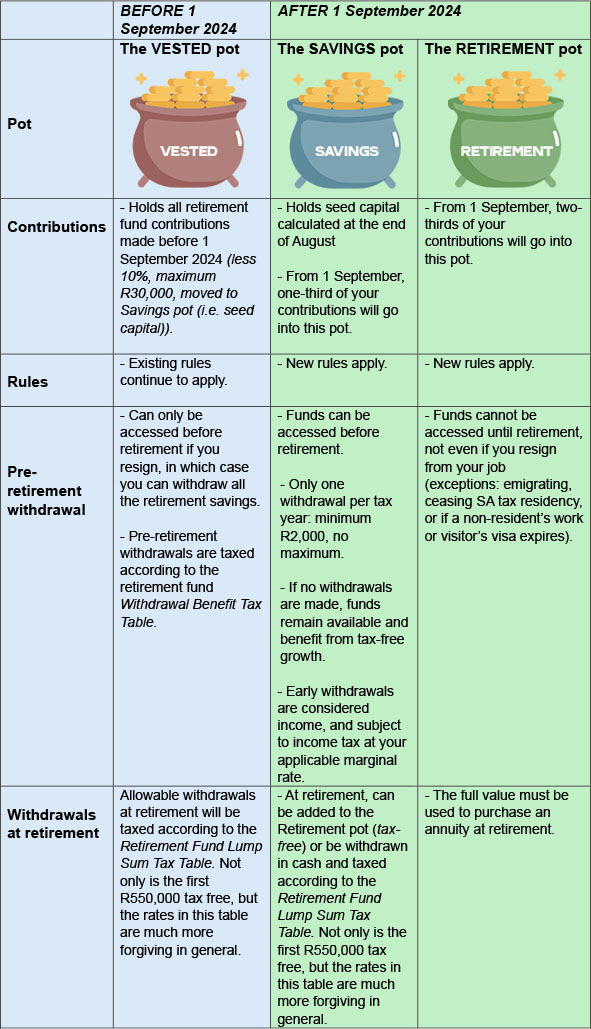
With two new pots added to what used to be the one-pot South African retirement system, fund members can now access a portion of their retirement savings before retirement, while still preserving savings for retirement. There are, however, immediate and long-term tax and other implications that should be carefully considered!

The three pots of the new retirement system

Tax and other issues

Withdrawing from any of the pots should be approached with caution. In addition to the fees that will be charged, and the potentially devastating impact on your eventual retirement savings, there are also tax implications that must be carefully considered.

  • It’s significantly more expensive from a tax perspective to withdraw retirement funds before retirement age (normally 55), because the Withdrawal Benefit Tax Table or Individual’s Tax Table will apply. Instead, waiting until retirement to access savings – when the Retirement Fund Lump Sum Benefits or Severance Benefits Tax Table applies – is a far better tax option.
  • Up to R550,000 drawn as a cash lump sum at retirement may be tax free. However, this R550,000 is a cumulative withdrawal total over your lifetime. That means this tax benefit could be eroded by pre-retirement withdrawals.
  • Transfers from the Vested and Savings pots into the Retirement pot are also tax-free.
  • Employer contributions are still treated as taxable fringe benefits.
  • Early withdrawals from your Savings pot are considered income and are subject to income tax as per the tax directive the fund manager will request from SARS. What’s more, any outstanding taxes you owe SARS will automatically be deducted if you make a withdrawal.
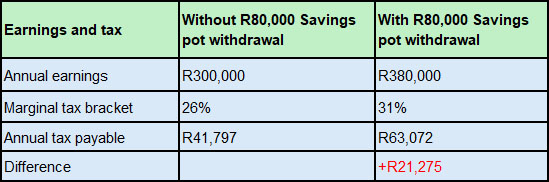
  • Depending on your annual income and the amount withdrawn, a pre-retirement withdrawal from your Savings pot – taxed at your individual marginal tax rate – could also push you into a higher tax bracket. This would mean paying more tax on all your income for the year. Here’s an example of the potential impact of withdrawing R80,000 from your Savings pot. Waiting until retirement age to withdraw the same amount could be tax-free.

Hidden costs of early withdrawals

Your full retirement fund contribution (one-third Savings pot; two-thirds Retirement pot) is still tax deductible up to 27.5% of annual income, up to a maximum R350,000 per tax year. This remains one of the biggest tax breaks out there, but is effectively cancelled out by the tax payable on an early withdrawal. Early withdrawals also have another cost – the loss of tax-free growth that could have been earned on your savings.

Continuing with the example above, if the R80,000 is not withdrawn, but instead left to grow at an average annual return of 10% for 25 years, the projected returns are R866,776 (equivalent to R201,958 in today’s terms assuming 6% inflation). This means you could lose tax-free growth of R121,958 by withdrawing just R80,000!

Help is at hand!

Understanding the tax and other implications of early retirement fund withdrawals in the short term and at retirement will help you to make better-informed financial decisions.

Early retirement fund withdrawals are likely to be more expensive in tax and lost investment growth compared to other options such as overdraft facilities, credit cards or home loans.

Please talk to us if you or any of your employees are considering retirement fund withdrawals. We’re here to help!

Disclaimer: The information provided herein should not be used or relied on as professional advice. No liability can be accepted for any errors or omissions nor for any loss or damage arising from reliance upon any information herein. Always contact your professional adviser for specific and detailed advice.

© CA(SA)DotNews

January 15, 2025
https://www.mfi.co.za/wp-content/uploads/2025/01/three-pots_650.jpg 300 650 MFI http://www.mfinc.co.za/wp-content/uploads/2023/09/cropped-cropped-MFI-Logo-Icon.jpg MFI2025-01-15 08:25:162026-03-13 07:52:00Beware the Taxman When Accessing Your Three-Pot Retirement Savings!

5 Top Tips for Managing Debt in Your Startup

Business

“There are no shortcuts when it comes to getting out of debt.” (Dave Ramsey, finance journalist and author)

Most businesses have debt of some kind or another. Whether you need help to buy stock, maintain equipment or even fund a property, it’s likely that at some stage in your business’ life you will need to take out loans. The challenge comes in balancing the needs of your business with the debt you’ve taken on in a way that ensures growth. Here are our five tips for managing debt in your startup.

1. Understand your debt

In order to successfully manage debt, you first need to fully understand it. As your accountants, we can help you create a complete spreadsheet of your debts detailing everything from the amounts owed, to interest rates, repayment schedules, and even penalties that may be triggered by late payments. This information will be critical for making the right choices.

2. N is for negotiate

Provided you have a good relationship with your lenders, your next step should be to try to renegotiate all your loans. Asking for lower interest rates, extended repayment terms or consolidation of debts could make the whole process of debt repayment simpler.

3. Not all debts are created equal

With your debts now in their healthiest place, it’s important to recognise that some debts are more important than others and thus need to be paid off first. Generally, you should aim to pay off high-interest loans first as these will cost you the most in the long run. Next you need to cover any debts which are secured by collateral – this will stop you from losing your assets in the future. Tax debts should also be prioritised as these can come with severe penalties and even criminal prosecution.

Sometimes the choices are not immediately obvious, so don’t be afraid to ask us for a debt repayment schedule which factors in your business’ operating conditions, cashflow and ultimate goals.

4. Improve cash flow

If you want to make sure your debt never becomes a problem, it’s vital that you improve the cash flow in your business to the point where you can meet your obligations. This can happen either through increasing sales, decreasing costs, or optimising operations – or from a combination of all three. For example, any money you can save on unnecessary expenses can go towards repaying your debt, lowering your interest payments and ultimately increasing the likelihood of success. It’s therefore essential that you work with us, your accountants, to optimise your inventory, cut costs, improve sales opportunities and chase your debtors and invoices to ensure prompt payment.

5. Monitor your debt carefully

Your repayment schedule should not be set in stone. It needs to be reviewed and adjusted regularly to account for any changes in your business condition. The goal here is not to be entirely free of debt, but rather to leverage debt for improved business growth. Managing debt is an ongoing process that could very likely last for the entire lifespan of your company.

The bottom line

Debt can be the leg-up your business needs – or the lead weight that holds it back. Speak to us to make sure it’s the former.

Disclaimer: The information provided herein should not be used or relied on as professional advice. No liability can be accepted for any errors or omissions nor for any loss or damage arising from reliance upon any information herein. Always contact your professional adviser for specific and detailed advice.

© CA(SA)DotNews

January 15, 2025
https://www.mfi.co.za/wp-content/uploads/2025/01/debt-management-650.jpg 300 650 MFI http://www.mfinc.co.za/wp-content/uploads/2023/09/cropped-cropped-MFI-Logo-Icon.jpg MFI2025-01-15 08:25:052026-03-13 07:52:005 Top Tips for Managing Debt in Your Startup

Is it Possible To Run a Successful Ethical Business?

Business

“It takes 20 years to build a reputation and 5 minutes to ruin it. If you think about that you will do things differently.” (Warren Buffett)

During tough economic times it can be tempting to illegally cut corners, hire staff at lower salaries, or avoid paying taxes you know you should be paying. The unethical approach can be very tempting if you find yourself battling to keep your business going. Taking the low road, would, however, be the wrong choice.

An ethical business is one that’s transparent and honest about everything from its accounting practices, to its treatment of employees, interactions with the public, and the information it shares with shareholders. Truly ethical companies put the wellbeing of their customers and employees on par with profits. Now, backed by repeated studies, the financial experts agree that running a business ethically isn’t just better for a business’ short-term success, it’s also far more profitable in the long run. But why?

Consumers demand ethical management

With climate change at the forefront of every modern consumer’s thinking, the demand for sustainable, and ethical business practices has never been higher. Company business practices are now easier to scrutinise and more consumers are taking an active interest in the ethical aspects of the companies they deal with. In short, customers want to buy from ethical businesses.

A recent study into consumer intent carried out by OpenText found that 88% of global consumers surveyed would rather buy from companies with ethical sourcing structures in place and that 83% of global respondents said they’d be willing to pay more for products they could be sure were ethically sourced.

The trickle-down effect

Moral and ethical business leadership has also been shown to reduce friction in teams and allow employees to better focus on their jobs. In a recent study, researchers at the University of Lahore revealed that supervisors who act ethically are more trusted by their employees and that this trust translates into boosted productivity from staff who are both more engaged and less emotionally exhausted. According to Gallup, teams which are highly engaged are, on average, 21% more productive and 28% less likely to steal from the company.

Big Brother is watching

When Volkswagen was ordered to pay back R201-billion to customers in the US who had been sold cars with falsified emissions data in 2015, the writing was on the wall for companies hoping to save money through unethical behaviour. In South Africa, you don’t need to look far for examples of large companies being brought to their knees by the unethical finance decisions of the boards. Steinhoff and Telkom have suffered for their questionable finance decisions and abusing their industry dominance respectively. And a R4.1-billion fine was issued to global software company SAP around bribes paid to South African and Indonesian officials to obtain valuable government business.

The truth is, regulators are looking at companies harder than ever before, and those who think they can slip through the legal cracks are increasingly finding themselves coming up short.

Being ethical will actually save you money

While many think ethical behaviour may cost more, there are multiple examples where “doing the right thing” has in fact led to a decrease in the cost of production. For instance, both PepsiCo and Hilton Worldwide have reported that their energy and waste-reduction strategies have resulted in billions of dollars in savings.

Onwards and upwards

Without a doubt, these are powerful incentives, and similar benefits can also be found for your company. Whether you want to install solar power to go greener and save money or ensure you never fall foul of obscure financial regulations, as your accountants, we are always ready to help.

Disclaimer: The information provided herein should not be used or relied on as professional advice. No liability can be accepted for any errors or omissions nor for any loss or damage arising from reliance upon any information herein. Always contact your professional adviser for specific and detailed advice.

© CA(SA)DotNews

January 15, 2025
https://www.mfi.co.za/wp-content/uploads/2025/01/business_ethics_650.jpg 300 650 MFI http://www.mfinc.co.za/wp-content/uploads/2023/09/cropped-cropped-MFI-Logo-Icon.jpg MFI2025-01-15 08:24:552026-03-13 07:52:00Is it Possible To Run a Successful Ethical Business?

How to Survive Trust Tax Season 2024

Tax

“A Trust is a ‘person’ for tax purposes and is therefore a taxpayer in its own right.” (SARS)

With Tax Season 2024 for trusts opening on 16 September, there’s no better time to draw trustees’ attention to SARS’ continued emphasis that all trusts must register for income tax purposes, including dormant trusts. Once registered, trusts are obligated to submit income tax returns that are aligned with other trust reporting requirements from SARS and substantiated by extensive supporting documents and information.

Trustees are held responsible for non-registration of trusts for income tax, and they will not be able to evade enforcement actions by blaming third parties for failing to file returns. “But I didn’t know I was meant to,” is not a valid excuse.

Trust tax returns can be filed from 16 September 2024 (much later than the usual June/July opening) until 20 January 2025.

Along with the new filing season dates, trusts also face several onerous compliance requirements – and some stiff potential penalties.

Onerous requirements
  • SARS introduced changes to the Income Tax Return for Trusts (ITR12T) last year, with additional probing questions, and even more mandatory supporting documents.
  • The range of mandatory and supporting documents that must be submitted with the ITR12T depends on the trust type, and may include:
    • All certificates and documents relating to income and deductions
    • Trust Deed and Letters of Authority
    • Resolutions/minutes of trustee meetings
    • Details of the ‘Main’ Trustee (the SARS registered representative)
    • Financial statements and/or administration accounts
    • Particulars of assets and liabilities
    • Confirmation of banking details
    • Proof of payment of any tax credits
    • Supporting schedules
  • Detailed disclosure of the beneficial ownership, including the submission of identity documents of all beneficial owners. This information will be checked against the beneficial ownership register lodged with the Master of the High Court. Non-compliance could result in a trustee receiving a fine of up to R10 million, a prison sentence of up to 5 years – or both.
  • To provide SARS with a clearer understanding of the assets, income and activities within trust structures, trust returns now feature additional questions such as any local or foreign amounts vested in the trust as a beneficiary of another trust.
  • Information reported on the trust tax return must also align with the IT3(t) reporting of prescribed information by trusts, now also mandated by SARS. It includes trust distributions and their beneficiaries, trust and beneficiary demographic information, trust financial flows, and amounts vested in a beneficiary, including net income, capital gains and capital amounts. The first IT3(t) certificates are due to be submitted at the end of September 2024 for the 2023/24 tax year, and then on an annual basis.
  • Despite the above reporting deadline, SARS confirmed that trust beneficiary income tax returns will not be pre-populated with IT3(t) data for the 2024 year of assessment. This means trustees must also provide details of trust beneficiaries’ 2024 trust earnings timeously to the beneficiaries for inclusion in their personal income tax returns, for which the submission deadlines remain unchanged despite the change in the trust tax filing season.
We can help you survive Tax Season 2024!

Without professional assistance, surviving trust Tax Season 2024 would be a tough ask. The complexity of the processes and the new requirements exponentially increase the risk of errors. And that’s before you factor in the significant time required to manually upload the extensive list of supporting documents – especially in light of SARS’ increased efforts to improve tax compliance and the severe penalties for non-compliance.

Luckily, you can rely on our friendly, professional assistance to ensure all the compliance boxes are ticked and penalties are avoided this trust Tax Season.

Disclaimer: The information provided herein should not be used or relied on as professional advice. No liability can be accepted for any errors or omissions nor for any loss or damage arising from reliance upon any information herein. Always contact your professional adviser for specific and detailed advice.

© CA(SA)DotNews

January 15, 2025
https://www.mfi.co.za/wp-content/uploads/2025/01/Trust_Tax_650.jpg 300 650 MFI http://www.mfinc.co.za/wp-content/uploads/2023/09/cropped-cropped-MFI-Logo-Icon.jpg MFI2025-01-15 08:24:442026-03-13 07:52:00How to Survive Trust Tax Season 2024

Your Tax Deadlines for September 2024

Tax
  • 06 September – Monthly Pay-As-You-Earn (PAYE) submissions and payments
  • 16 September – Start of Filing Season 2024: Trusts
  • 25 September – Value Added Tax (VAT) manual submissions and payments
  • 27 September – Excise duty payments
  • 30 September – VAT electronic submissions and payments, Corporate Income Tax Provisional Tax payments where applicable, and Personal Income Tax Top-up Provisional Tax payments.

Disclaimer: The information provided herein should not be used or relied on as professional advice. No liability can be accepted for any errors or omissions nor for any loss or damage arising from reliance upon any information herein. Always contact your professional adviser for specific and detailed advice.

© CA(SA)DotNews

January 15, 2025
https://www.mfi.co.za/wp-content/uploads/2025/01/7b3c62b7-249c-4a1f-9edd-81833d2f718b.png 298 650 MFI http://www.mfinc.co.za/wp-content/uploads/2023/09/cropped-cropped-MFI-Logo-Icon.jpg MFI2025-01-15 08:24:322026-03-13 07:52:01Your Tax Deadlines for September 2024
Page 3 of 3123

Pages

  • About
  • Accounting and Banking
  • Careers
  • Careers-PTA01
  • Contact
  • Financial Planning
  • HOME
  • Latest News
  • Medical Practice Management
  • MFI Team
  • Testimonials

Categories

  • Accounting
  • Business
  • Company / Corporate / Compliance
  • DotNews
  • Economy
  • Employment and Labour
  • Employment and Labour Law
  • Financial
  • Investment
  • Tax
  • Technology
  • Trusts
  • Uncategorized
  • Wills and Estate Planning

Archive

  • July 2026
  • June 2026
  • May 2026
  • April 2026
  • March 2026
  • January 2026
  • November 2025
  • October 2025
  • September 2025
  • August 2025
  • July 2025
  • June 2025
  • May 2025
  • April 2025
  • March 2025
  • February 2025
  • January 2025
  • July 2023
  • June 2023
  • May 2023
  • April 2023
  • March 2023
Standard POPI Act Privacy Policy Statement

Scroll to top